
Purushottam Maas Katha Chapter 30
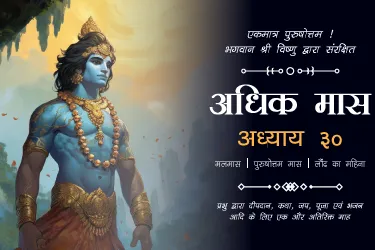
In chapter 30 of the Purushottam Maas Katha, the story of an exceptionally qualified and highly virtuous person is given. In this story, a king named 'Dharmabuddhi' was an extremely virtuous and religious person. Several important events about his life are described that demonstrate his spiritual advancement and religious ethics. Through this story, readers are taught the importance of simple human qualities and conduct, which presents an inspiring example of a high-level life. In this chapter, the righteousness, virtue, and morality of King Dharmabuddhi are prominent, guiding readers towards religious and moral progress.
Naradji said, 'O ascetic! You have praised the chaste woman before, now tell me all her characteristics.
Sutji said, 'O Brahmins, gods of the earth! Thus, upon being asked by Narad Muni, the ancient sage Narayan himself spoke about the characteristics of a chaste woman.
Shri Narayan said, 'O Narad! Listen, I will tell you about the best vows of chaste women. Whether the husband is ugly, of bad behavior, or handsome, sick, a ghost, angry, a drunkard, foolish, mute, blind, or deaf, terrible, poor, miserly, condemned, humble, or attached to other women. But a virtuous woman should always worship her husband as a god with her speech, body, and actions. A woman should never behave harshly with her husband.
Whether young, youthful, or old, a woman should not do any work independently in her own home. Always abandoning ego and lust-anger, she should always please her husband's mind and never please the mind of another. If a woman, upon being seen by another man with desire, being tempted by sweet words, or being touched in a crowd, does not become disturbed, then for every hair on the woman's body, she resides in heaven for thousands of years.
If a woman, upon being tempted by another man's wealth, does not serve another man with her mind, words, and deeds, then that woman is called an ornament and virtuous in the world. Even upon being pleaded by a messenger, being forcibly caught, or being covered with clothes and ornaments, if a woman does not serve another man, then she is called virtuous. A woman who does not look when seen by another and does not laugh when laughed at, and does not speak when spoken to, is a chaste woman with excellent characteristics.
Even if she is endowed with beauty and youth and skilled in singing and dancing, she does not become disturbed upon seeing a man who is not her husband, that woman is virtuous. Even upon meeting a handsome, young, charming man who is dear to women, if a woman does not desire him, then she is called a great virtuous woman.
Chaste women do not cherish any other god, man, or Gandharva besides their husband, therefore a woman should never do anything displeasing to her husband. She who eats after her husband has eaten, is saddened when he is sad, is happy when he is happy, wears dirty clothes when he goes abroad, sleeps when her husband sleeps and wakes up before him, enters the fire when her husband dies, and does not desire another with her heart, is a chaste woman. She is devoted to her mother-in-law and father-in-law and especially devoted to her husband, remains favorable in religious activities, favorable in accumulating wealth, and is always diligent in household chores.
When the husband comes from the field, forest, or village, the woman should rise and please him by offering a seat and water, always be cheerful, give food at the right time, never speak bad words while eating, the chief woman in the house should always be diligent in providing a seat, food, charity, respect, and sweet speech, she should save some money wisely from the wealth given by the husband for household expenses, she should not be greedy and stingy with the money given for charity, and should not give wealth to her relatives without her husband's permission, a chaste woman should abandon talking with others, discontent, talking about other men's affairs, excessive laughter, excessive anger and rage, a chaste woman should abandon whatever the husband does not drink, whatever he does not eat, whatever he does not consume, a chaste woman should apply oil, bathe, apply ubtan to the body, and cleanse her teeth for the pleasure of her husband.
O sage! From the Treta Yuga, women have menstruation every month, from that day, after three days of abstinence, she becomes pure for household work. On the first day, she is a Chandalini, on the second day, a Brahmahatyini, on the third day, a Rajaki. On the fourth day, she becomes pure.
A woman in menstruation should not bathe, cleanse, sing, cry, laugh, ride, massage, gamble with women, apply sandalwood, especially sleep during the day, brush her teeth, engage in mental or verbal intercourse, worship deities, or salute deities. Do not touch or talk to a woman in menstruation. A woman in menstruation should not show her face for three nights. She should not let her words be heard until she takes a purifying bath. A woman in menstruation should not look at another man after bathing, she should look at Suryanarayan, then drink Panchagavya. She should drink only Panchagavya or milk for her purification. A noble woman should abide by the rules that have been said.
If a woman becomes pregnant, she should be diligent in following the rules, adorned with clothes, ornaments, and jewelry, and diligently engaged in pleasing her husband. She should be cheerful, diligent in her dharma, and pure, protect herself and be adorned, and be diligent in Vastu Puja. She should not talk to bad women, the air from a winnowing fan should not touch her body, a pregnant woman should not have contact with those who have lost their children, and should not eat at another's house. She should not look at ugly things, should not listen to terrible stories, should not eat heavy and extremely hot food, and should eat food that does not cause indigestion. By living in this way, a chaste woman obtains an excellent son, otherwise the pregnancy may be lost or stopped.
She should not condemn another co-wife who is inferior to her in qualities, even if there is jealousy, envy, etc., the co-wives should not speak unpleasant words to each other, should not sing the name of another and should not praise another, should not live far from her husband, but should live near her husband and in the place said by her husband, facing her husband on the earth. She should not look freely in the directions and should not look at another man. She should look at her husband's lotus face with affection, and the woman should listen with respect to the story told by her husband. The woman should not talk herself during her husband's speech, a woman with eagerness in love should go to the place of love quickly when called by her husband. The woman should listen with a cheerful heart when her husband sings with enthusiasm, the woman should be immersed in joy upon seeing her singing husband, the woman should not sit near her husband with a distracted (restless) mind, even if there is a reason for quarrel, the woman should not quarrel with her husband. Even if she is scolded, condemned, or beaten by her husband, the chaste woman, even if distressed (sad), should leave fear and embrace her husband, should not cry loudly and should not curse her husband, the woman should not run away from her house, if she goes to festivals etc. at her relatives' house, she should go with her husband's permission and protected by a guardian and should not stay there for a long time, the chaste woman should return to her home.
During her husband's foreign travel, she should not speak inauspicious words, should not forbid him with prohibitive words, and should not cry at that time. When her husband goes abroad, she should not apply ubtan daily and the woman should not do condemned deeds for the sake of survival. She should sleep near her father-in-law and mother-in-law, should not sleep elsewhere, and should diligently inquire about her husband's news every day. She should send a messenger to get good news about her husband and make auspicious requests near famous deities. The chaste woman should do such things when her husband goes abroad. Not washing the limbs, wearing dirty clothes, not applying tilak, not applying collyrium, abandoning fragrant substances, garlands, etc., not grooming nails and hair, not applying missi etc. to the teeth, laughing loudly, laughing with others, especially contemplating the gait and behavior of others, wandering freely, massaging the limbs of another man, wandering with one garment, walking without shame (lying down), etc. are said to be extremely painful defects for women.
After doing household chores, she should purify her body with turmeric paste and pure water and wear clean makeup. She should go near her husband with a cheerful face like a blooming lotus, a woman with this behavior and with her mind, words, and body, when called by her husband, should leave household chores and go to her husband quickly and say, "O Lord! Why have you called me, please tell me." She should not stand at the door for a long time. She should not use the door, she should never give to another the thing received from her husband, she should always be happy saying that the leftover sweet, food, fruit, etc. of her husband is Mahaprasad, she should sleep happily, sit happily, enjoy freely, and should not wake up her husband in urgent tasks, she should not go anywhere alone, she should not bathe naked, she should not consider a woman who hates her husband to be chaste.
A chaste woman should never sit on a mortar, pestle, broom, stone, machine, or threshold. A woman who desires to bathe in a pilgrimage should drink the water from her husband's feet, for a woman, her husband is said to be greater than even Shankar or Vishnu Bhagwan.
A woman who does not obey her husband's words and performs vows, fasts, and rules, takes away her husband's life and goes to hell after death. If a woman answers back to her husband angrily when going somewhere for some work, she becomes a bitch in the village and a jackal in the deserted forest.
It has been said that there is only one excellent rule for women, that a woman should always worship her husband's feet and then eat. A woman who abandons her husband and eats sweets alone becomes a cruel owl sleeping in the hollow of a tree. A woman who abandons her husband and wanders alone in solitude becomes a sow in the village or a monitor lizard that eats its own excrement. A woman who speaks unpleasant words to her husband with a grunt is sure to be mute, a woman who is always jealous of her co-wife is unfortunate in her next life. A woman who looks at another man while avoiding her husband's gaze becomes one-eyed or ugly and repulsive.
A woman who, upon seeing her husband coming from outside, quickly serves her husband with water, a seat, betel, dishes, pressing his feet, etc., with extremely sweet words, is said by scholars to be like the crown jewel among chaste women. The husband is a god, the husband is a guru, the husband is dharma, pilgrimage, and vows, therefore, abandoning everything else, one should worship only the husband.
Just as a body without life becomes impure in a moment, similarly, a woman without a husband is always impure even after bathing well. A widow is extremely inauspicious compared to all inauspicious things, work is never accomplished by seeing a widow. Except for a mother who gives blessings, one should abandon the blessings of another woman like a snake.
Brahmins make the bride say at the time of marriage that she will be a companion in the living and dead state of her husband. Therefore, one should follow her husband like her own shadow. In this way, a chaste woman should always be in harmony with her husband with devotion.
Just as a snake catcher forcefully pulls a snake out of its hole, similarly, a virtuous woman rescues her husband from the messengers of Yama and takes him to heaven. The messengers of Yamaraj, seeing a chaste woman from afar, leave even her fallen husband who commits sinful deeds and run away. For as many hairs as there are on her body, the chaste woman enjoys heavenly pleasures with her husband for ten crore years.
Women with wicked behavior destroy their character and drown both families and remain miserable in this world and the next. If, by chance, she does not follow her husband after his death, then even in that condition, she should protect her character, because breaking her character leads to hell. Because of the woman's faults, the father and husband fall from heaven. The widow's hair knot is for the bondage of her husband.
A widow should always shave her head, eat once, and never eat a second time. A widow who sleeps on a cot causes her husband to fall down, therefore, for the happiness of her husband, she should sleep on the ground. She should not apply ubtan to her limbs and should not eat betel, a widow should not use fragrance. She should offer libations to her husband daily with Kusha, sesame seeds, and water, and offer libations by saying the name and gotra of her husband's father and his father. She should always wear white clothes, otherwise she goes to Raurava hell. A widow with these rules is chaste.
Shri Narayan said, 'There is no deity in the worlds and among the gods equal to the husband. When the husband is pleased, she attains all her desires. If the husband is angry, all desires are destroyed. From that husband, one obtains children, various kinds of pleasures, bed, seat, wonderful kinds of food, clothes, garlands, fragrant substances, and various kinds of fame in this world and in heaven.
Thus ends the thirtieth chapter in the Purushottam Maas Mahatmya of the Shri Brihannaradiya Purana. ॥30॥
Today's Panchang 8 September 2026
For auspicious times, choghadiya, horoscope and planetary positions
Related Articles

Purushottam Maas Katha | पुरुषोत्तम मास माहात्म्य
पुरुषोत्तम मास, जिसे मलमास के नाम से जाना जाता था, श्रीकृष्ण के वरदान से विशेष महत्व प्राप्त करता है। इस माह में तप, पूजा, दान, कथा श्रवण से अनंत पुण्य…

Purushottam Maas Katha: Adhyaya 4 | पुरुषोत्तम मास कथा: अध्याय 4 |
अधिमास, शरणागत होकर भगवान विष्णु से अपने तिरस्कार और कष्ट की व्यथा कहता है। करुणा से द्रवित भगवान विष्णु अधिमास को स्वीकारते हैं और उसे आश्वासन देते हैं। श्रीनारायण बोले, …

Purushottam Maas Katha: Adhyaya 10 | पुरुषोत्तम मास कथा: अध्याय 10
दुर्वासा मुनि ने कन्या को पुरुषोत्तम मास का महत्व बताया, लेकिन उसने उसे नकारा। फिर दुर्वासा ने उसे शाप देने के बजाय, शिव की तपस्या करने की सलाह दी। नारद…

Purushottam Maas Katha: Adhyaya 11 | पुरुषोत्तम मास कथा: अध्याय 11
कथा में एक तपस्विनी कन्या ने भगवान शिव की कठोर तपस्या की। शिवजी ने उसे पाँच पति का वर दिया, लेकिन कन्या ने इसे अस्वीकार कर दिया, और पुरुषोत्तम मास…

Purushottam Maas Katha: Adhyaya 12 | पुरुषोत्तम मास कथा: अध्याय 12
यह कथा पुरुषोत्तम मास के महात्म्य और भगवान श्रीकृष्ण के उपदेशों पर आधारित है। नारदजी ने भगवान से पूछा कि जब शिवजी गए, तो तपस्विनी कन्या पर क्या बीती। श्री…

Purushottam Maas Katha: Adhyaya 13 | पुरुषोत्तम मास कथा: अध्याय 13
इस अंश में ऋषि राजा दृढधन्वा की कथा सुनाते हैं, जो अपनी समृद्धि पर चिंतन करते हुए आध्यात्मिक ज्ञान प्राप्त करने के लिए दिव्य उपदेशों से एक बदलाव का अनुभव करते हैं।