
Shrimad Bhagavad Gita Chapter 1 Verse 3 | Duryodhana's First Address to Dronacharya | Full Meaning and Explanation
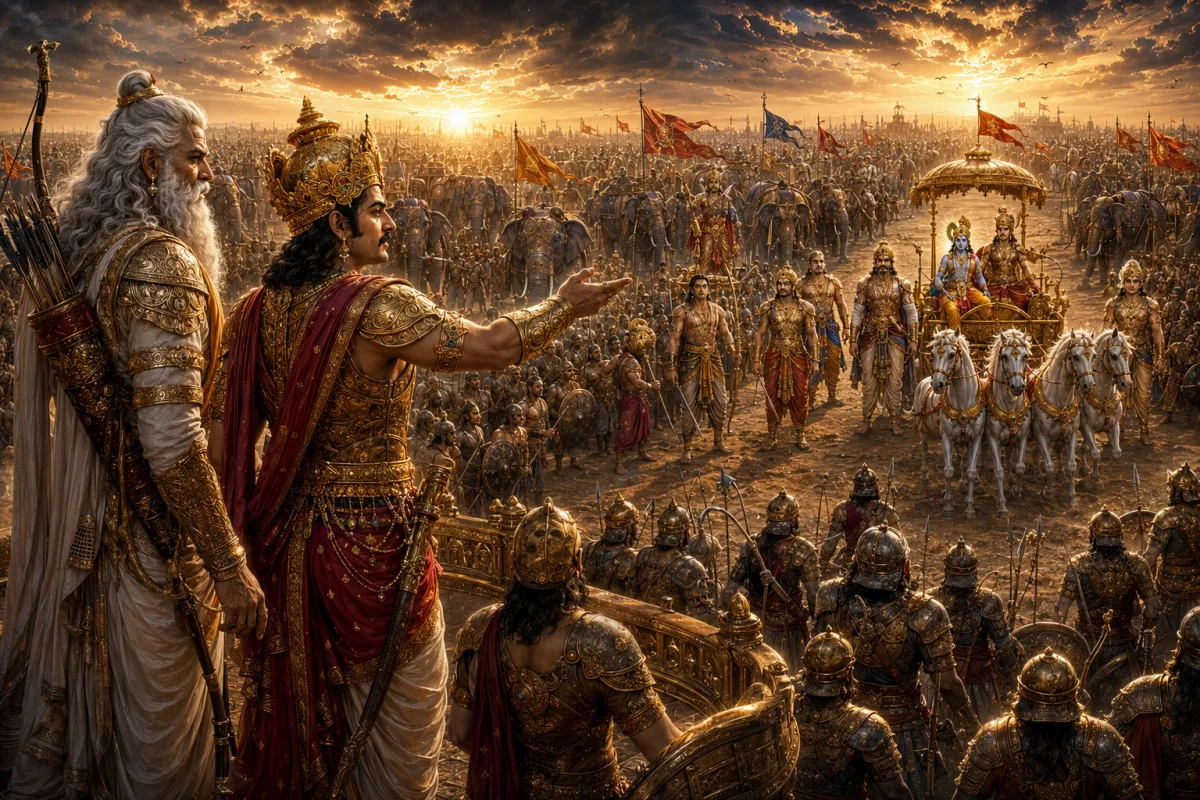
Shrimad Bhagavad Gita Chapter 1, Verse 3
paśyaitāṁ pāṇḍuputrāṇāmācārya mahatīṁ camūm |
vyūḍhāṁ drupadaputréṇa tava śiṣyéṇa dhīmatā ||3||
Word Meanings
| Sanskrit Word | Hindi Meaning |
|---|---|
| पश्य (paśya) | See |
| एताम् (etām) | This |
| पाण्डुपुत्राणाम् (pāṇḍuputrāṇām) | Of the sons of Pandu |
| आचार्य (ācārya) | O Teacher |
| महतीम् (mahatīm) | Great |
| चमूम् (camūm) | Army |
| व्यूढाम् (vyūḍhām) | Arranged in formation |
| द्रुपदपुत्रेण (drupadaputréṇa) | By Drupada's son |
| तव (tava) | Your |
| शिष्येण (śiṣyéṇa) | Disciple |
| धीमता (dhīmatā) | Intelligent |
Simple Hindi Meaning
Duryodhana said to Dronacharya—
"O Teacher! Behold this great army of the sons of Pandu, arranged in formation by your own intelligent disciple, Drupada's son."
This verse may seem ordinary at first glance, but each word within it carries deep strategy and psychological undertones. Duryodhana was not merely pointing out the army; he was also reminding his guru, Dronacharya, of their past history and the current situation.
This Crucial Moment of the Mahabharata War
The Mahabharata war was about to begin. Both armies stood in battle formation on the vast plains of Kurukshetra. The conch shells had sounded, and every warrior was ready at their post.
At this moment, Duryodhana's gaze fell upon the Pandava army. He saw not just brave warriors, but an army that was extremely disciplined and strategically organized.
Duryodhana immediately approached his guru, Dronacharya, and first asked him to look towards the Pandava army. This was not just an act of informing; a specific purpose was hidden behind his words.
He specifically used the words "Drupada's son" and "your disciple." This was no coincidence. Duryodhana knew that there was an old enmity between Dronacharya and King Drupada. Therefore, he wanted to awaken the memory of that old insult in Dronacharya's mind, so that he would fight with full might for the Kaurava side.
Who Was Dhrishtadyumna?
The son of Drupada mentioned in the third verse of the first chapter of the Bhagavad Gita refers to Dhrishtadyumna. He was the son of King Drupada of Panchala and the brother of Draupadi. According to the Mahabharata, Dhrishtadyumna was not born in the usual way but emerged from a special sacrifice.
There was an old enmity between King Drupada and Acharya Drona. Dronacharya, with the help of his disciples, defeated Drupada in battle and took half of his kingdom. To take revenge for this insult, King Drupada performed a special Putresthi Yajna (sacrifice for progeny).
From the sacrificial fire, two divine children emerged—Dhrishtadyumna and Draupadi. A celestial voice declared that Dhrishtadyumna would later become the cause of Dronacharya's death, while Draupadi would play a significant role in the great events of the Mahabharata.
Thus, Dhrishtadyumna's birth itself was for a special purpose. He was not just a prince but a great character destined by fate.
The Story of Dronacharya and King Drupada
Dronacharya and Drupada studied together in the same gurukul during their childhood. At that time, they were deeply friendly. Drupada had told Drona in his childhood that when he became king, he would give half of his kingdom to his friend.
As time passed, Drupada became the king of Panchala, while Dronacharya's life was spent in very ordinary circumstances. One day, Dronacharya went to meet his old friend, but King Drupada refused to consider him a friend and insulted him.
This incident deeply hurt Dronacharya's heart. Later, with the help of his disciples—especially Arjuna—he defeated Drupada in battle and took half of his kingdom.
This same incident later led to the birth of Dhrishtadyumna. Therefore, when Duryodhana said, "By Drupada's son, your disciple," he was not just introducing the army; he was also bringing forth the most painful memory of Dronacharya's life.
Duryodhana's Political Acumen
Duryodhana was a very shrewd politician. He chose his words with extreme care. If his intention was merely to show the army, he could have simply said, "The Pandava army," and finished the conversation.
However, he specifically stated that this army was arranged by "your intelligent disciple." Hearing this statement, several emotions could naturally arise in Dronacharya's mind—pride, surprise, and the memory of past insults.
Duryodhana wanted Dronacharya to forget any affection for his disciples Arjuna and Dhrishtadyumna and fight with complete loyalty for the Kaurava side. This was a form of psychological pressure.
This incident clearly shows that wars are not won solely by weapons; words and psychology also play a crucial role.
The True Meaning of the Phrase "Tava Shishyena"
The most impactful part of this verse is—tava śiṣyéṇa dhīmatā, meaning "by your intelligent disciple."
Dhrishtadyumna was born with the purpose of killing Dronacharya, yet ironically, Dronacharya himself trained him in archery and warfare. This is a wonderful example of a guru's impartiality and dedication to education.
Dronacharya never let his personal enmity become an obstacle in the path of education. He imparted knowledge to a deserving disciple, even if that disciple was destined to stand against him in the future.
Duryodhana sought to use this very fact to create mental turmoil in Dronacharya's mind. Therefore, this phrase is considered the deepest psychological point of the entire verse.
The Profound Significance of This Verse
This verse of the Bhagavad Gita does not merely describe a battlefield; it illustrates the profound impact of words in life. In a single sentence, Duryodhana connected elements of the guru, disciple, old enmity, strategy, and psychology.
This verse also teaches us that in any difficult situation, a person's true character is revealed through their words and actions. Duryodhana's intelligence was commendable, but his intentions were not righteous. Therefore, his strategy ultimately did not bring him victory.
On the other hand, Dronacharya's character inspires us with impartiality, knowledge, and the fulfillment of duty. He upheld his duty as a guru, rising above his personal relationships.
"The true guru of knowledge is one who upholds truth and duty above personal interest."
Psychological Analysis of Duryodhana's Words
The third verse of the first chapter of the Bhagavad Gita is not just a simple dialogue; it is a mirror to Duryodhana's state of mind. At first glance, it appears that he is merely drawing Dronacharya's attention to the Pandava army, but his words contain psychological signals at multiple levels.
Duryodhana knew that the army standing before him was not just of five brothers, but comprised many great warriors, wielders of divine weapons, and experienced commanders. He also knew that Lord Krishna himself was present with the Pandavas. Therefore, along with confidence, a subtle anxiety had also arisen in his mind.
For this reason, before the war began, he deemed it appropriate to communicate with his most important guru, Dronacharya. This behavior indicates that he was a ruler who studied situations meticulously.
However, his words contained not just respect, but also a hidden message. He wanted Dronacharya to remember his old enmity and his duty as a disciple, and to fight with complete dedication for the Kaurava side.
Dhrishtadyumna's Warfare Strategy
Duryodhana specifically emphasized that the formation of the Pandava army was created by Dhrishtadyumna. This mention was not merely for introduction.
Dhrishtadyumna was an extremely skilled master of warfare. He had received his martial training from Dronacharya himself. Therefore, he was well aware of the strengths and weaknesses of the Kaurava army.
The greatest quality of a skilled commander is not just bravery, but also the ability to form the right formation at the right time on the battlefield. Dhrishtadyumna organized the Pandava army in such a way that each great warrior could fight to their best ability.
Seeing this arrangement, Duryodhana understood that not only was there a powerful army before him, but also extremely intelligent leadership.
Dronacharya's Potential State of Mind
When Duryodhana said—"tava śiṣyéṇa dhīmatā", it was not just a statement of fact; it was a sentence that touched Dronacharya's inner being.
Dronacharya had taught his disciples impartially throughout his life. He made Arjuna the best archer and also taught warfare to Dhrishtadyumna, even though he knew that the latter might become the cause of his death in the future.
For such a guru, the battlefield was an extremely difficult situation. On one side was his royal duty, and on the other stood his beloved disciples. Duryodhana attempted to exploit this mental state.
This episode teaches us that in life, duty and emotions often stand in opposition. Making the right decision at such times is the true test.
Leadership Principles Derived from This Verse
This verse of the Bhagavad Gita presents many important principles of modern leadership.
- Thoroughly study the opponent before any competition.
- Strategy should be based on information, not just strength.
- Competent leadership boosts the confidence of the entire team.
- Timely and appropriate communication is a crucial leadership skill.
- Psychology is an integral part of strategy.
- Not just resources, but their proper utilization is also essential.
- A leader must make decisions after understanding every aspect of the situation.
These same principles apply equally today in corporate management, administration, politics, and business.
Spiritual Interpretation of This Verse
From a spiritual perspective, Duryodhana represents the ego, greed, and selfishness present within us. The Pandavas, on the other hand, symbolize truth, faith, patience, self-control, and righteousness.
When virtues are organized and stand together within a person, negative tendencies begin to feel insecure. This is the situation of Duryodhana in this verse.
Dhrishtadyumna's well-arranged formation indicates that self-development is also not possible without discipline and practice. Just as an army is organized, a person must also organize their thoughts, emotions, and actions.
This is why the Bhagavad Gita is not just a text about war, but also a great scripture of self-management.
Application of This Verse in Daily Life
This verse is still applicable in our lives in many ways today.
- Prepare thoroughly before any exam.
- Study your competitors in business.
- Understand all sides before making decisions in the family.
- Keeping the team organized in the office is the key to success.
- Make decisions with wisdom rather than emotion.
When a person proceeds with preparation, discipline, and righteousness, their chances of success increase manifold.
"Organized virtues are the greatest basis for victory in every battle of life."
Adi Shankaracharya's Explanation
According to Adi Shankaracharya, Duryodhana's intention in this verse was not merely to show the Pandava army. He deliberately draws Dronacharya's attention to the fact that the Pandava army's formation was created by Drupada's son, Dhrishtadyumna, who is himself Dronacharya's disciple.
Shankara indicates that through this statement, Duryodhana wanted to awaken the memory of Dronacharya's old enmity in his mind. The conflict between Dronacharya and King Drupada was the very reason for Dhrishtadyumna's birth. Therefore, Duryodhana wanted Dronacharya to fight for the Kauravas with full enthusiasm and firm resolve.
This explanation shows that Duryodhana was not just a warrior but also a skilled politician who tried to turn circumstances to his advantage.
Shri Ramanujacharya's Explanation
Shri Ramanujacharya considers this verse an important stage in God's divine plan. According to him, Duryodhana was outwardly displaying confidence, but within him, there was both respect and concern for the organized power of the Pandavas.
Ramanujacharya explains that the side of righteousness is always more organized and stable because it is supported not only by human strength but also by God's grace. Therefore, Duryodhana's concern was not just due to seeing the military strength, but he was also sensing the unseen power that accompanies righteousness.
Shri Madhvacharya's Explanation
According to Madhvacharya, this verse symbolizes the eternal conflict in the world. Duryodhana represents unrighteousness, ego, and selfishness, while the Pandavas symbolize righteousness, truth, and devotion to God.
When unrighteousness witnesses the organized power of righteousness, it naturally becomes unstable. This is why Duryodhana attempts to boost his army's morale and mentally motivate Dronacharya even before the war begins.
Madhvacharya considers this verse an initial sign of the victory of self-control and devotion to righteousness.
Philosophical Interpretation of This Verse
The philosophical message of this verse is very profound. The well-organized army of the Pandavas is not just a group of soldiers but a symbol of discipline, patience, wisdom, and truth in life.
Conversely, Duryodhana's fear indicates that unrighteousness can never be completely at ease. No matter how much power it possesses, insecurity remains within it.
This verse teaches us that inner character is more important than external resources. If a person's mind is filled with truth, righteousness, and confidence, they can face even the most difficult situations.
Importance of This Verse in Modern Leadership and Management
This verse is also highly relevant today in the corporate world, administration, business, and social leadership.
1. Team Organization
A team that is organized and has a clear goal can face any major challenge. The Pandava army is the best example of this.
2. Communication in Leadership
A leader must know how to communicate with the right person at the right time. Duryodhana went directly to his commander and guru because he knew that the direction of the war is influenced by leadership.
3. Emotional Intelligence
The impact of words is not limited to information. They also inspire and influence. Duryodhana's words are an example of this.
4. Respect for Competition
One should never underestimate any competitor. The first rule of success is to accept reality.
Inspiring Lessons for Life
- Righteousness and discipline are the greatest strengths.
- Organization is the first step to success.
- Always respect a worthy guru.
- Ethics are as essential as strategy.
- Ego weakens a person from within.
- Past events should be handled wisely, not allowed to become a cause of animosity.
- Wise leadership is the greatest asset in times of crisis.
- The path of truth and righteousness may be difficult, but it ultimately leads to victory.
Spiritual Message
"A person who walks organized with righteousness achieves victory not through external power, but through inner conviction."
This verse of the Bhagavad Gita teaches us that every conflict in life is not merely a result of external circumstances. The real battle takes place within our thoughts, decisions, and character. When our life is based on righteousness, discipline, and faith in God, no difficulty can permanently defeat us.
Practical Application of This Verse in Life
The third verse of the first chapter of the Bhagavad Gita does not just describe the Mahabharata war; it also offers many inspirations for modern life. What Duryodhana said to Dronacharya teaches us that before facing any challenge, it is essential to understand its true nature.
Success in life is not achieved merely by enthusiasm, but by proper planning, right leadership, a disciplined team, and wise decisions. Just as Dhrishtadyumna organized the Pandava army, every person should also organize their life, time, thoughts, and actions.
This verse also teaches us that external power alone is not sufficient. If the objective is not righteous, even the greatest power can ultimately be defeated.
The Main Message of This Verse
"Organization, strategy, and righteousness—these three together create lasting victory."
Duryodhana recognized the power of the Pandavas, but he did not understand the power of righteousness. On the other hand, despite having limited resources, the Pandavas had righteousness, discipline, and the guidance of Lord Krishna. This is why, in the end, righteousness prevailed.
10 Key Lessons from This Verse
- Assess any challenge correctly first.
- Competent leadership can change the direction of the entire team.
- Organization is the greatest power for success.
- Respect experienced gurus and mentors.
- Ethics are as essential as strategy.
- Use words thoughtfully, as they have a profound impact on the mind.
- Use past events for inspiration, not for animosity.
- A true leader makes decisions after understanding the situation.
- Power without righteousness is not lasting.
- Faith in God and self-discipline ultimately lead to success.
Frequently Asked Questions (FAQs)
Who is speaking in Bhagavad Gita Chapter 1, Verse 3?
In this verse, Duryodhana is conversing with his guru, Dronacharya.
Who was Drupada's son?
Drupada's son refers to Dhrishtadyumna, who was the son of King Drupada and the commander of the Pandava army.
What does "tava śiṣyéṇa" mean?
It means—"by your disciple." Here, Duryodhana is reminding Dronacharya that their disciple Dhrishtadyumna has arranged the formation of the Pandava army.
Why did Duryodhana specifically mention Dhrishtadyumna?
He wanted to mentally motivate Dronacharya for the war by reminding him of their old enmity and the purpose of Dhrishtadyumna's birth.
What is the main message of this verse?
Understanding the importance of strategy, organization, leadership, and a righteous purpose is the core message of this verse.
Is this verse useful in modern life?
Yes. It is equally useful in leadership, business, education, administration, family, and self-development in every field.
Today's Panchang 24 September 2026
For auspicious times, choghadiya, horoscope and planetary positions
Related Articles
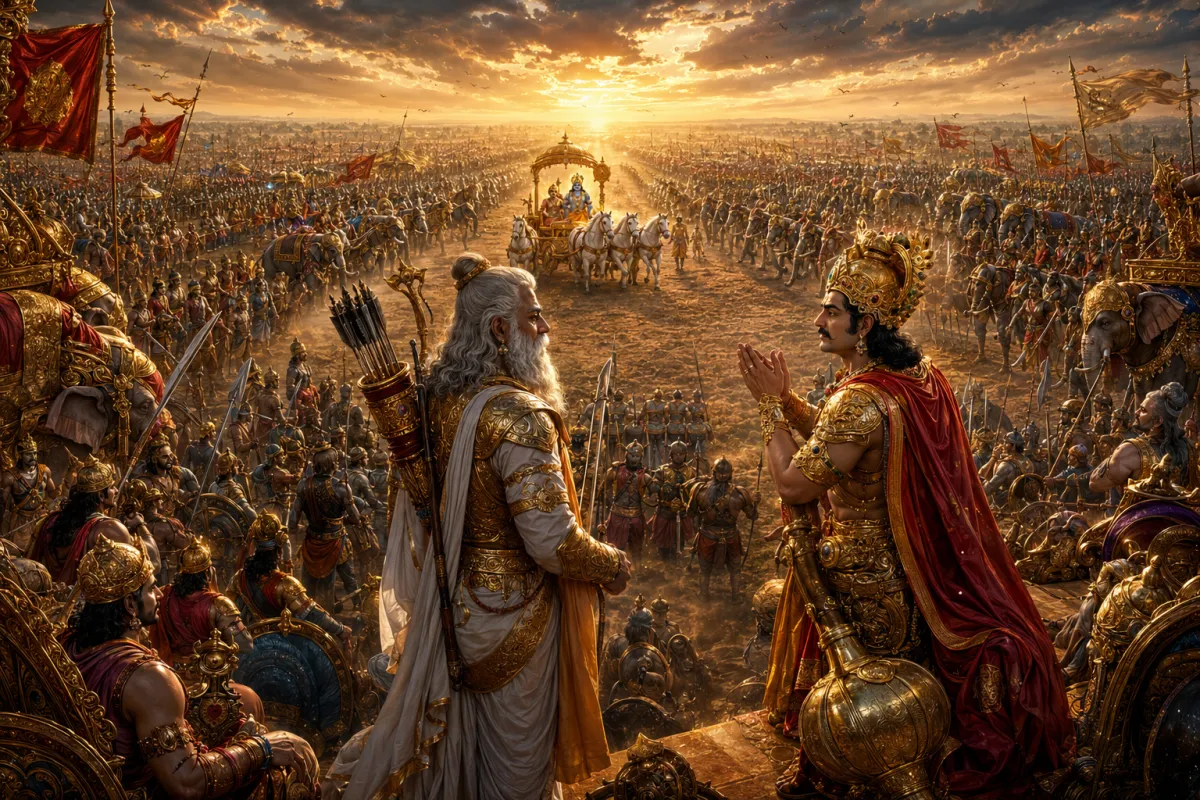
Shrimad Bhagavad Gita Chapter 1 Verse 2 | Duryodhana's Dialogue with Dronacharya | Complete Meaning and Explanation
श्रीमद्भगवद्गीता के प्रथम अध्याय का दूसरा श्लोक महाभारत युद्ध के प्रारम्भिक वातावरण को और अधिक स्पष्ट करता है। इस श्लोक में दुर्योधन पाण्डवों की विशाल सेना को देखकर अपने गुरु द्रोणाचार्य के पास जाता है। उसके शब्दों में आत्मविश्वास दिखाई देता है, किंतु उसके भीतर छिपी चिंता और रणनीतिक सोच भी स्पष्ट रूप से दिखाई देती है। आइए इस श्लोक का शब्दार्थ, सरल अर्थ और गहन महत्व विस्तार से समझते हैं।
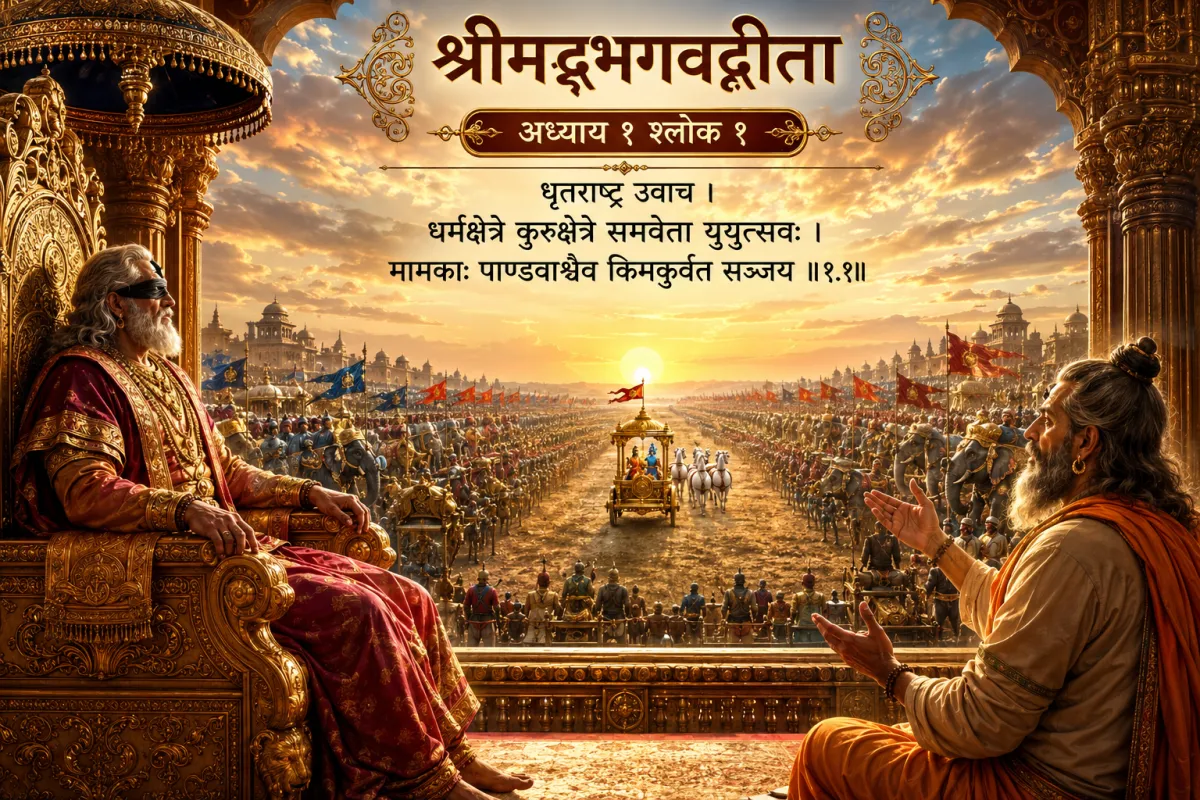
Shrimad Bhagavad Gita Chapter 1 Verse 1 – Dhritarashtra Uvacha: Dharmakshetre Kurukshetre… | Complete Meaning, Word-by-Word Meaning, and Detailed Introduction
भगवद्गीता का प्रथम श्लोक केवल युद्धभूमि का वर्णन नहीं है, बल्कि मानव मन, धर्म, कर्तव्य और मोह के बीच चलने वाले आंतरिक संघर्ष का भी प्रतीक है। आइए जानें इस श्लोक का गहरा अर्थ और इसका आध्यात्मिक संदेश।

Chapter 18 : Moksha Sanyasa Yoga – अध्याय १८: मोक्षसंन्यासयोगः
अर्जुन उवाच: सन्यासस्य महाबाहो तत्त्वमिच्छामि वेदितुम् । त्यागस्य च हृषीकेश पृथक्केशिनिषूदन ।। अर्जुन बोले- हे महाबाहो ! हे अन्तर्यामिन् ! हे वासुदेव ! मैं संन्यास और त्यागके तत्त्वको पृथक्- पृथक्…

Chapter 17 : Shraddha Traya Vibhaga Yoga – अध्याय १७: श्रद्धात्रयविभागयोग
अर्जुन उवाच: ये शास्त्रविधिमुत्सृज्य यजन्ते श्रद्धयान्विताः । तेषां निष्ठा तु का कृष्ण सत्त्वमाहो रजस्तमः ।। अर्जुन बोले- हे कृष्ण ! जो मनुष्य शास्त्रविधिको त्यागकर श्रद्धासे युक्त हुए देवादिका पूजन करते…

Chapter 16 : Daivasura Sampad Vibhaga Yoga – अध्याय १६: दैवासुरसम्पद्विभागयोग
श्रीभगवानुवाच: अभयं सत्त्वसंशुद्धिर्ज्ञानयोगव्यवस्थितिः । दानं दमश्च यज्ञश्च स्वाध्यायस्तप आर्जवम् ॥ श्रीभगवान् बोले- भयका सर्वथा अभाव, अन्तःकरणकी पूर्ण निर्मलता, तत्त्वज्ञानके लिये ध्यानयोगमें निरन्तर दृढ़ स्थिति और सात्त्विक दान, इन्द्रियोंका दमन, भगवान्,…
Chapter 15 : Purushottama Yoga – अध्याय १५: पुरुषोत्तमयोग
श्रीभगवानुवाच ऊर्ध्वमूलमधः शाखमश्वत्थं प्राहुरव्ययम् । छन्दांसि यस्य पर्णानि यस्तं वेद स वेदवित् ॥ श्रीभगवान् बोले- आदिपुरुष परमेश्वररूप मूलवाले और ब्रह्मारूप मुख्य शाखावाले’ जिस संसाररूप पीपलके वृक्षको अविनाशी कहते हैं, तथा...