
Why Did Krishna Have 16,108 Wives? The True Story and Secrets from Scriptures
📋 Table of Contents
- Introduction:
- Ashtabharya (8 Principal Queens):
- The Terror of Narakasura (Bhaumasura) and the Captivity of 16,100 Maidens:
- Satyabhama's Resolve and the Slaying of Narakasura:
- The Crisis of Social Ostracization and Lord Krishna's Assurance:
- Philosophical & Symbolic Meaning:
- Lord Krishna and the 16,108 Queens: A Quick Summary
- Frequently Asked Questions (FAQs)
- Conclusion:
- Read Also (Related Mythological & Krishna Stories)
Introduction:
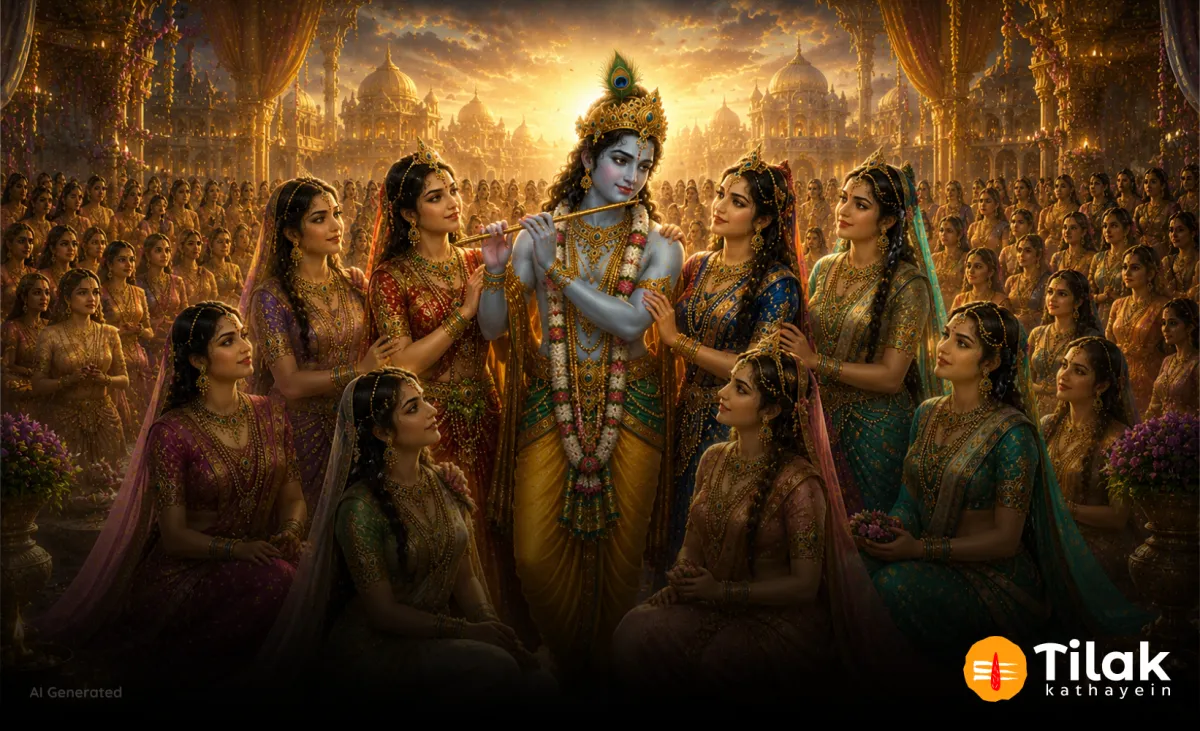
In the history of Sanatana Dharma and the collective consciousness, whenever the topic of Lord Krishna's complete incarnation and his divine pastimes arises, a question often surfaces due to doubt or ignorance—Why did Krishna have 16,108 wives? Modern society often mistakenly views this through the lens of worldly desires or sensual indulgence, whereas its true basis is connected to the respect for women, compassion, social dignity, and the philosophy of spiritual non-duality.
The answer to Why did Krishna have 16108 wives is found not just in some fictional tale, but in the authentic verses of the Srimad Bhagavatam Mahapurana (10th Canto), Vishnu Purana, and Mahabharata. This marriage of Lord Krishna was not a result of the desire for worldly pleasure, but a divine shield of protection given to those helpless, captive, and ostracized maidens to grant them the highest honor of queens in society.
"Namo Bhagavate Tasmāi Krishnāyādbhutakarmaṇe.
Rūpaṁ yat sarvabhūtānāṁ jīvanāya ca kevalam॥"
(Meaning: Salutations to Lord Krishna, the performer of wondrous deeds, whose every action and incarnation is solely for the welfare, protection, and sustenance of all beings.)
Ashtabharya (8 Principal Queens):
According to mythological accounts, Lord Krishna primarily had 8 principal queens, known in the scriptures as Krishna Ashtabharya names. The marriage of the Lord with all these goddesses was duly solemnized based on different specific circumstances, vows, swayamvaras (self-choice ceremonies), and devotional sentiments:
- 1. Rukmini (Rukmini): Daughter of King Bhishmaka of Vidarbha, who was an incarnation of Mahalakshmi herself. Goddess Rukmini sent a love letter to Krishna, considering him her everything, after which the Lord abducted her and duly married her.
- 2. Satyabhama (Satyabhama): The exceedingly beautiful daughter of Satrajit, considered an aspect of Mother Earth (Bhudevi). Her marriage to Krishna took place after the resolution of the Syamantaka jewel incident.
- 3. Jambavati (Jambavati): Daughter of the immortal warrior of the Ramayana era, King Jambavan. A fierce wrestling match took place between Krishna and Jambavan for 27 days over the Syamantaka jewel, after which Jambavan recognized the Lord and offered his daughter to him.
- 4. Kalindi (Kalindi): Daughter of Surya (the Sun God) and the human form of the Yamuna River. She performed severe penance to have Krishna as her husband.
- 5. Mitravinda (Mitravinda): The princess of Avanti (Ujjain) and the daughter of Krishna's aunt, who chose the Lord in a swayamvara.
- 6. Nagnajiti / Satya (Nagnajiti): Daughter of King Nagnajit of Kosala kingdom. Krishna fulfilled the condition of her swayamvara by taming seven uncontrollable and fierce bulls simultaneously.
- 7. Bhadra (Bhadra): The princess of Madra country, whose marriage was duly performed with Krishna by her brothers.
- 8. Lakshmana (Lakshmana): Daughter of the King of Madra, who won the difficult challenge of piercing a fish by looking at its reflection in the water, similar to the Draupadi swayamvara, and chose Krishna.
Thus, Krishna's 8 principal queens were the chief queens of his royal palaces. The story of the remaining 16,100 maidens is directly linked to the slaying of Narakasura.
The Terror of Narakasura (Bhaumasura) and the Captivity of 16,100 Maidens:
The second and most crucial part of the Krishna 16108 wives story is related to King Narakasura (Bhaumasura) of Pragjyotisha (present-day Guwahati region of Assam). Narakasura was born from the union of Earth (Bhudevi) during the Varaha Avatar, but due to the company of wicked demons like Kalnemi, he became extremely cruel and tyrannical.
In his arrogance from the boon of immortality granted by Lord Brahma, he wreaked havoc in all three worlds. He attacked the heavens, snatched Indra's Airavata elephant, Varuna's divine umbrella, and even the nectar-like divine earrings of Aditi, the mother of the gods.
Furthermore, driven by his lust and arrogance of power, Narakasura attacked various kings, Gandharvas, sages, and common families of Aryavarta, abducting 16,100 beautiful and innocent maidens. He held all these maidens captive in chains in his impenetrable fortress of 'Pragjyotisha'. These maidens were insulted daily and constantly shed tears, awaiting the avatar of the Lord.
Satyabhama's Resolve and the Slaying of Narakasura:
When Lord Indra narrated his plight and the insult to Mother Aditi to Lord Krishna in Dwarka, Krishna resolved to completely destroy the wicked Narakasura.
Narakasura had received a boon that his death was possible only at the hands of his mother (Earth). Coincidentally, Queen Satyabhama was an incarnation of Bhudevi herself. When Satyabhama learned that Narakasura had imprisoned thousands of helpless maidens, she insisted on going to the battlefield herself.
- Journey on Garuda: Lord Krishna, accompanied by Queen Satyabhama, rode on Garuda and reached Pragjyotisha.
- Slaying of the Demon Mura: The city was surrounded by a formidable array of water, fire, wind, and sharp weapons. Krishna destroyed all obstacles with his Sudarshana Chakra and slew the five-headed demon 'Mura', after which he became known as 'Murari'.
- End of the Tyrant: In a fierce battle, when Krishna feigned unconsciousness due to Narakasura's arrows, Satyabhama, extremely enraged, took up her bow and struck Narakasura with deadly blows. Finally, Lord Krishna unleashed his Sudarshana Chakra, severing the head of that sinner. This event occurred on the fourteenth day of the dark fortnight of the month of Kartik, which we celebrate today as Naraka Chaturdashi (Choti Diwali).
The Crisis of Social Ostracization and Lord Krishna's Assurance:
After the slaying of Narakasura, when Krishna and Satyabhama opened the prison gates, the scene was extremely heart-wrenching. The 16,100 princesses and maidens were languishing in tattered clothes, suffering from hunger, thirst, and fear. Seeing the Lord before them, they wept tears of joy.
However, immediately after this joy of liberation, a very grave social crisis loomed before them:
- Social Narrow-mindedness and Rejection: According to the strict rules of the then society, a woman who had been imprisoned by a stranger or a demon for months or years was considered 'unchaste' and impure. Neither their parents were willing to accept them back, nor could any noble man dare to marry them.
- Decision for Collective Suicide: The maidens joined their hands and said to Krishna—"O Lord of Dwarka! Even if you free us from here, society will look upon us with disdain. We will have no option but to endure insult or commit mass suicide (Jal Samadhi)."
- Lord Krishna's Supreme Assurance (Marriage as Protection): The essence of Why Lord Krishna married 16100 women lies in this very moment. The ocean of compassion, Krishna, did not delay even for a moment. He declared: "From today, you all will be considered my queens. Your place in Dwarka will be equal to that of the principal queens."
By performing Krishna marriage with 16100 queens, Lord Krishna bestowed upon all those maidens his sacred name, lineage, and the supreme honor of being queens of Dwarka. In the same society where they would have lived as slaves or impure women, that society began to bow its head at their feet, considering them the Lord's wives. There is no other historical and humanitarian example of this magnitude of respect and rehabilitation for women found elsewhere in world history.
Philosophical & Symbolic Meaning:
The Srimad Bhagavatam is not merely a historical text; it is an ocean of pure spirituality and philosophy. The episode of the 16,108 queens reveals several profound secrets from a philosophical perspective:
1. 16,108 Nadis and Kundalini Yoga
According to Hatha Yoga and Tantric scriptures (especially the Shiva Samhita and Goraksha Paddhati), there are considered to be a total of 72,000 nadis (energy channels) in the subtle spinal cord system of the human body, of which 16,108 nadis are considered extremely important and conscious. Lord Krishna is the Supreme Consciousness (Pure Soul), and the 16,108 queens symbolize these subtle energy channels (nadis). When each nadi is filled with the nectar of divine love, only then does the soul experience supreme bliss.
2. Non-dual Union of the Soul and the Supreme Being
According to Indian Advaita Vedanta, in this world, the only 'Purusha' (the existence of Sat-Chit-Ananda) is the Supreme Brahman, the Lord; all souls are in the form of 'Prakriti' (nature). These 16,100 maidens were actually those virtuous souls and sages from past lives who, upon seeing Lord Rama's beauty in the Treta Yuga, desired him as their husband. In the Dvapara Yuga, the Lord accepted their selfless devotion and absorbed them into himself.
3. The Astonishment of Devarshi Narada and Omnipresence
When Devarshi Narada became curious about how Krishna managed his household life with 16,108 wives, he arrived in Dwarka. Narada saw that 16,108 divine palaces had been built in Dwarka. When he entered the first palace, he saw the Lord conversing with Rukmini; in the second palace, he saw him playing chaupar with Satyabhama; in the third palace, he was playing with children; and in the fourth palace, he was performing a yajna. Krishna had manifested 16,108 independent divine forms simultaneously. This is irrefutable proof that Krishna is omnipresent, unborn, and the Yogeshwara, the Supreme Brahman.
Lord Krishna and the 16,108 Queens: A Quick Summary
| Subject / Reference | Scriptural & Authentic Description |
|---|---|
| Total Number of Queens | 16,108 (8 Principal Queens + 16,100 Rescued Maidens) |
| 8 Principal Queens (Ashtabharya) | Rukmini, Satyabhama, Jambavati, Kalindi, Mitravinda, Nagnajiti, Bhadra, and Lakshmana |
| Captor of the 16,100 Maidens | The cruel demon Narakasura (Bhaumasura) of Pragjyotisha |
| Ally in the Slaying of Narakasura | Queen Satyabhama (Incarnation of Bhudevi) & Garuda Dev |
| Primary Purpose of Marriage | To provide honor as 'Queens' in society, protecting them from insult, social ostracization, and suicide. |
| Yogic & Philosophical Symbolism | The 16,108 major subtle nadis of the human body & the non-dual union of the Supreme Being and the soul. |
| Authentic Textual Sources | Srimad Bhagavatam (Tenth Canto), Vishnu Purana, Harivamsa Purana, and Mahabharata |
Frequently Asked Questions (FAQs)
1. Did Lord Krishna have children from his 16,108 wives?
According to the Srimad Bhagavatam, Lord Krishna had children only from his 8 principal queens (Ashtabharya), with each bearing 10 sons and one daughter (e.g., Pradyumna from Rukmini and Samba from Jambavati). The relationship of Lord Krishna with the remaining 16,100 maidens was not one of sensual desire, but entirely of social security, protection of motherhood, and spiritual guardianship.
2. Was the marriage with 16,100 maidens worldly or spiritual?
This marriage transcended worldly desires and was an act of historical and social salvation. Had Krishna not accepted them as his wives, the narrow-minded society of that era would not have allowed them to live, deeming them 'impure'. By granting them the status of queens, the Lord made them revered in society.
3. What is the connection between the slaying of Narakasura and Diwali?
Lord Krishna and Satyabhama slew Narakasura on the fourteenth day of the dark fortnight of the month of Kartik. In the joy of the liberation of 16,100 maidens and the end of unrighteousness, people lit lamps, which we celebrate today as 'Naraka Chaturdashi' or 'Roop Chaudas'.
4. What is the difference between the Ashtabharya and the 16,100 maidens?
The Ashtabharya were the 8 principal queens with whom Krishna's marriage took place through scriptural swayamvaras, valor, and family customs. The 16,100 maidens were those pure souls rescued from Bhaumasura's prison, whom the Lord sheltered to provide them with a respectable place in society.
Conclusion:
The episode of Lord Krishna's 16,108 queens is by no means a subject of physical or worldly indulgence. It is a saga of a supreme being who, even in that era, broke societal norms to protect the dignity, honor, and rights of women. In the same society that had abandoned those helpless princesses, Yogeshwara Krishna made them equal in respect to the thrones of Hastinapur and Dwarka by making them his queens.
Philosophically, Krishna is that Absolute Brahman with whom, upon uniting, every soul is freed from the bonds of birth and death. This sacred episode conveys to us that true dharma lies not in rituals, but in the protection of the helpless, compassion, and the establishment of women's self-respect.
"Yadā yadā hi dharmasya glānirbhavati Bhārata.
Abhyutthānamadharmasya tadātmānaṁ sṛjāmyaham॥
Paritrāṇāya sādhūnāṁ vināśāya ca duṣkṛtām.
Dharmasaṃsthāpanārthāya saṃbhavāmi yuge yuge॥"🚩 Om Namo Bhagavate Vasudevaya! Jai Shri Krishna! Jai Dwarkadhish! 🙏🪔🌸
Read Also (Related Mythological & Krishna Stories):
- Who was Radha Ji? Was Radha Ji an Incarnation of Lakshmi? Understand the profound secret of Radha Rani's manifestation and her Hladini Shakti according to the Brahmavaivarta and Padma Purana.
- Why Did Shakuni Attain Heaven Despite All His Sins? The deep mystery of the Mahabharata's Swargarohana Parva and the subtle principle of karma.
- When a Crocodile Grabbed Guru Drona's Leg: That inspiring episode from the Mahabharata when Guru Dronacharya, pleased with Arjuna's devotion, bestowed the Brahmashira Astra.
- Shri Somnath Jyotirlinga and Bhalka Tirth: The history of the first Jyotirlinga and the episode of Lord Krishna's departure from the mortal world in Prabhas Kshetra.
Today's Panchang 31 October 2026
For auspicious times, choghadiya, horoscope and planetary positions
Related Articles
Why is Yama's lamp lit on Dhanteras? Know the correct method and secrets
कार्तिक मास के कृष्ण पक्ष की त्रयोदशी (धनतेरस) की शाम को दक्षिण दिशा में मृत्यु के देवता यमराज के निमित्त जो विशेष दीपक प्रज्वलित किया जाता है, उसे 'यमदीप' (यम का दीया) कहते हैं। स्कंद पुराण और पद्म पुराण के अनुसार, धनतेरस के दिन यमराज के निमित्त चार मुखी दीपदान करने से परिवार के सदस्यों को अकाल मृत्यु, दुर्घटना और यम यातनाओं के भय से मुक्ति मिलती है। यह दीपक घर के मुख्य द्वार के बाहर दक्षिण दिशा की ओर मुख करके अन्न की ढेरी पर रखा जाता है।
Sharad Purnima: Time for Kheer, Puja Vidhi & Mythological Story
हिन्दू पंचांग के अनुसार आश्विन शुक्ल पूर्णिमा को 'शरद पूर्णिमा' या 'शरद पूनम' (कोजागरी पूर्णिमा) कहा जाता है। मान्यता है कि इस पावन रात्रि को चंद्रमा पृथ्वी के सर्वाधिक निकट होता है और अपनी संपूर्ण 16 कलाओं से अमृत की किरणें बरसाता है। इस रात खुले आकाश के नीचे गाय के दूध और चावल से बनी खीर (गुजरात में दूध-पौंआ) रखने की परंपरा है। मध्यरात्रि में धन की देवी माता लक्ष्मी "को जागर्ति" (कौन जाग रहा है?) पूछते हुए पृथ्वी पर विचरण करती हैं और जागरण करने वाले भक्तों को अखंड ऐश्वर्य का वरदान देती हैं।
Why did Shakuni attain heaven despite all his sins? Know the secret
महाभारत के 'स्वर्गारोहण पर्व' के अनुसार, शकुनि को स्वर्ग मिलने के तीन प्रमुख कारण हैं। पहला, उसने कुरुक्षेत्र की पावन भूमि पर क्षत्रिय धर्म का पालन करते हुए सहदेव के विरुद्ध सम्मुख लड़कर वीरगति प्राप्त की थी। दूसरा, कर्मफल के शास्त्रीय नियम के अनुसार, जिस जीव के पाप अधिक और पुण्य बहुत कम होते हैं, उसे अपने अल्प पुण्यों का भोग करने के लिए पहले कुछ समय के लिए स्वर्ग प्राप्त होता है, जिसके समाप्त होने पर वह दीर्घकालीन नरक में जाता है। तीसरा, यह युधिष्ठिर के अहंकार और द्वेष की शुद्धि के लिए देवराज इंद्र और धर्मराज द्वारा रची गई एक मायावी परीक्षा थी।
Why are the stories of Garuda Purana important today? Know the significance and lessons
गरुड़ पुराण केवल मृत्यु उपरांत की यात्रा या नरक की यातनाओं का विवरण नहीं है, बल्कि यह वर्तमान जीवन में नैतिकता, दया, और सदाचार से जीने का एक आध्यात्मिक मार्गदर्शक है। आधुनिक युग में जब भौतिक सुखों के पीछे भागते हुए लोग नैतिक मूल्य भूल रहे हैं, तब गरुड़ पुराण का 'कर्मफल का सिद्धांत' मनुष्य को जिम्मेदार, संवेदनशील और न्यायप्रिय बनने की गहरी सीख देता है।
Why did Lakshman not sleep for 14 years? Know the secret of the Goddess of Sleep
रामायण के अनुसार, 14 वर्ष के वनवास के दौरान भगवान राम और माता सीता की निरंतर सेवा व रक्षा करने के लिए लक्ष्मण ने निद्रा देवी से 14 वर्षों तक न सोने का वरदान मांगा था। निद्रा देवी की शर्त के अनुसार, लक्ष्मण के हिस्से की 14 वर्ष की नींद उनकी पत्नी उर्मिला ने अयोध्या के राजमहल में सोकर पूरी की। नींद पर विजय पाने के कारण ही लक्ष्मण 'गुड़ाकेश' कहलाए और इसी वरदान के बल पर वे ब्रह्मचारी व अनिद्राधारी रहकर अजेय योद्धा मेघनाद (इंद्रजीत) का वध कर सके।
7 Verses from the Bhagavad Gita That Teach Self-Confidence and Self-Reliance
**भगवद्गीता** केवल आध्यात्मिक ज्ञान का ग्रंथ नहीं, बल्कि जीवन की कठिन परिस्थितियों में सही मार्ग दिखाने वाला दिव्य संदेश है। कुरुक्षेत्र में भगवान श्रीकृष्ण ने अर्जुन को ऐसे अनेक उपदेश दिए, जो आज भी आत्मविश्वास, कर्म, धैर्य और स्वयं पर विश्वास रखने की प्रेरणा देते हैं। इस लेख में जानें **भगवद्गीता के 7 शक्तिशाली श्लोक**, उनके सरल हिंदी अर्थ और जीवन में मिलने वाली ऐसी सीखें, जो कठिन समय में अपने निर्णय और क्षमता पर भरोसा करना सिखाती हैं।