
7 Verses from the Bhagavad Gita That Teach Self-Confidence and Self-Reliance
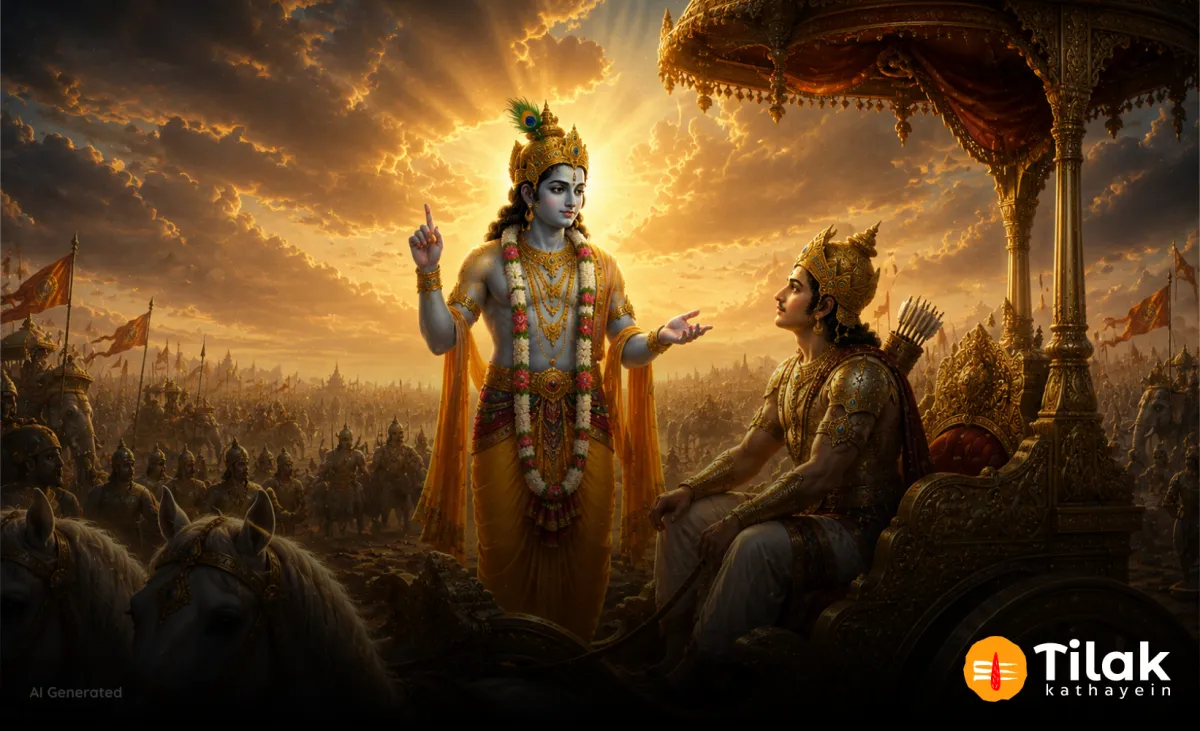
7 Verses from the Bhagavad Gita That Teach You Self-Belief | Teachings of Lord Krishna
In life, there are many occasions when we start doubting our own capabilities. Failure, criticism, difficult circumstances, or worries about the future can weaken us from within. In such times, the teachings of Shrimad Bhagavad Gita show us the way to recognize our inner strength.
On the battlefield of Kurukshetra, Arjuna was also going through a similar mental struggle. His own gurus, relatives, and loved ones stood before him. He was confused and worried about his duty. The knowledge that Lord Krishna imparted to him then was not just for war, but became guidance for every difficult situation in life.
In the Gita, self-confidence does not merely mean feeling that we can do everything. It has a deeper meaning—believing in your duty, your capabilities, and the right path, and not retreating due to fear of the outcome.
Let us learn about 7 such verses from the Bhagavad Gita that explain to us the importance of self-belief, patience, and the power of action.
1. Believe in Action, Not in the Fear of Results
Bhagavad Gita — Chapter 2, Verse 47
Verse:
karmaṇy-evādhikāras te mā phaleṣu kadācana |
mā karma-phala-hetur bhūr mā te saṅgo ’stv-akarmaṇi ||
Simple Meaning: Man has a right only to his actions, never to their fruits. Therefore, do not let the fruits of action be your motive, nor be attached to inaction.
How Does This Verse Increase Self-Confidence?
Often, we do not start a task because we fear that the outcome will not be in our favor. Lord Krishna tells us that the outcome is not always in our control, but our effort is in our hands.
Therefore, when starting an exam, job, business, or any new goal, instead of backing down due to fear of the outcome, one should focus on putting in their best effort.
Today's Lesson: Reduce worry about the outcome and trust the quality of your effort.
2. Be the Cause of Your Own Upliftment
Bhagavad Gita — Chapter 6, Verse 5
Verse:
uddhared ātmanātmānaṁ nātmānam avasādayet |
ātmaiva hy ātmano bandhur ātmaiva ripur ātmanaḥ ||
Simple Meaning: One must elevate oneself by one's own self; one should not degrade oneself. For one's mind can be one's best friend or one's worst enemy.
What is the Connection of This Verse with Self-Confidence?
Many times, our biggest obstacle is not another person, but our own fear, negative thinking, and self-doubt.
Lord Krishna reminds us that it is important to learn to control our mind and thoughts. If we constantly consider ourselves weak, our capabilities will be affected.
Today's Lesson: Challenge negative perceptions about yourself and recognize your potential.
3. Act According to Your Nature and Capabilities
Bhagavad Gita — Chapter 3, Verse 35
Verse:
śreyān svadharmo viguṇaḥ paradharmāt sv-anuṣṭhitāt |
svadharme nidhanaṁ śreyaḥ paradharmo bhayāvahaḥ ||
Simple Meaning: It is better to perform one's own duty, though imperfectly, than to perform another's duty perfectly. It is better to die in the discharge of one's own duty than to engage in another's duty, for to follow another's path is fraught with danger.
Its Meaning in Today's Life
Comparing ourselves to others can weaken self-confidence. In an era of social media and competition, we often feel that others are more successful than us.
The Gita teaches us to focus on our own path. Every person's capabilities, circumstances, and journey are different.
Today's Lesson: Instead of imitating someone else's success, believe in your own capabilities and your own path.
4. Learn to Make Your Mind Your Friend
Bhagavad Gita — Chapter 6, Verse 6
Verse:
bandhur ātmano ’s tasya yen-ātmaiv-ātmanā jitaḥ |
anātmanas tu śatrutve vartet-ātmaiva śatruvat ||
Simple Meaning: For one who has conquered the mind, the mind is the best of friends. But for one who has failed to do so, the mind will remain the greatest enemy.
Self-confidence does not come solely from external achievements. If our mind is constantly filled with fear, anxiety, and negative thoughts, we cannot utilize our full potential despite having the capability.
Today's Lesson: Learn to control your mind and do not let negative thoughts define you.
5. Remain Balanced Instead of Fearing Failure
Bhagavad Gita — Chapter 2, Verse 48
Verse:
yoga-sthaḥ kuru karmāṇi saṅgaṁ tyaktvā dhanañjaya |
siddhy-asiddhyoḥ samo bhūtvā samatvaṁ yoga ucyate ||
Simple Meaning: Perform your duty equipoised, O Arjuna, abandoning all attachment to success and failure. Such equanimity is called yoga.
Why is This Important for Self-Confidence?
If our self-image depends solely on success, then one failure can break us completely. But if we adopt an attitude of learning from both success and failure, our self-confidence becomes more stable.
Today's Lesson: Do not let failure define you. Consider it an opportunity to learn and improve.
6. Maintain Patience and Perseverance in Difficult Times
Bhagavad Gita — Chapter 2, Verse 14
Verse:
mātrā-sparśās tu kaunteya śītoṣṇa-sukha-duḥkha-dāḥ |
āgamāpāyino ’nityās tāṁs-titikṣasva bhārata ||
Simple Meaning: O son of Kunti, the contact of the senses with the objects of sense gives rise to heat and cold, pleasure and pain. These are transient and appear and disappear. Therefore, you should patiently endure them, O descendant of Bharata.
No situation in life remains the same forever. Difficult times also change, and good times also bring change.
This thought gives us the strength to maintain patience in difficult circumstances instead of breaking down.
Today's Lesson: Do not give up by considering the current problem as a permanent future.
7. Recognize the Divine Power Within You
Bhagavad Gita — Chapter 6, Verse 7
Verse:
jitātmanaḥ praśāntasya paramātmā samāhitaḥ |
śītoṣṇa-sukha-duḥkheṣu tathā mānāpamāṇayoḥ ||
Simple Meaning: For one who has conquered the mind and is completely tranquil, the Supreme Self is within reach. Such a person remains steady in heat and cold, pleasure and pain, and honor and dishonor.
The Deep Lesson of This Verse
True self-confidence does not depend on external praise. If we consider ourselves great when someone praises us and feel weak when someone criticizes us, then our self-confidence goes into the hands of others.
The Gita teaches us to be stable from within. When a person gains control over their mind and develops an understanding of their true self, external circumstances do not easily disturb them.
Today's Lesson: Determine your worth by your character and actions, not by others' opinions.
A Glance at the Teachings of the 7 Bhagavad Gita Verses
| Sr. No. | Verse | Main Teaching |
|---|---|---|
| 1 | Chapter 2, Verse 47 | Focus on Action |
| 2 | Chapter 6, Verse 5 | Uplift Yourself |
| 3 | Chapter 3, Verse 35 | Believe in Your Path |
| 4 | Chapter 6, Verse 6 | Make Your Mind Your Friend |
| 5 | Chapter 2, Verse 48 | Remain Balanced in Success and Failure |
| 6 | Chapter 2, Verse 14 | Be Patient in Difficult Times |
| 7 | Chapter 6, Verse 7 | Recognize Your Inner Strength |
According to Lord Krishna, What is the True Meaning of Self-Confidence?
In the Bhagavad Gita, self-confidence does not mean arrogance or assuming that we can change every situation according to our will. Instead, the Gita leads us towards self-control, discernment, duty, and equanimity.
True self-confidence comes when a person understands that they can remain honest in their actions, maintain patience in difficult situations, and learn from the outcome, whatever it may be, and move forward.
How to Adopt These Verses in Today's Life?
- Break down a big goal into small tasks and focus on your actions daily.
- Focus on your progress instead of comparing yourself to others.
- Learn from failure instead of blaming yourself after it.
- When negative thoughts arise, do not immediately accept them as truth.
- Take both praise and criticism from others with a balanced perspective.
- In difficult situations, remember that time keeps changing.
- Consider fulfilling your duty honestly as the first step to success.
Frequently Asked Questions (FAQs)
1. Which verse from the Bhagavad Gita is most famous for self-confidence?
Chapter 6, Verse 5 of the Bhagavad Gita inspires self-upliftment—one must elevate oneself and not weaken oneself.
2. Does the Bhagavad Gita teach self-belief?
Yes. The Gita provides teachings on self-control, belief in one's duty, controlling the mind, and remaining balanced in difficult situations. All these can be helpful in strengthening self-confidence.
3. What does the 'Karmaṇyevādhikāraste' verse of the Gita teach?
This verse teaches that our primary right is to our actions. Therefore, instead of excessively worrying about the outcome, one should perform their duty with honesty and full capability.
4. Is reading the Gita useful after a failure?
The teachings of the Gita can help in viewing failure not as the ultimate truth of life, but from the perspective of equanimity, patience, and action.
5. How did Lord Krishna give Arjuna self-confidence?
Lord Krishna gave Arjuna knowledge of his duty, the nature of the soul, Karma Yoga, and equanimity. This removed Arjuna's confusion and made him firm in his duty.
Conclusion
These 7 verses from the Bhagavad Gita remind us that self-confidence is not just about thinking we will never fail. True self-confidence means performing the right actions with faith in your capabilities, maintaining patience in difficult times, and remaining balanced in both success and failure.
Arjuna's struggle also teaches us that sometimes even the most powerful person can go through confusion and self-doubt. But right knowledge, wisdom, and understanding of one's duty can help them stand up again.
Therefore, whenever you doubt yourself in life, remember these teachings of the Gita—believe in your actions, make your mind your friend, and honestly keep moving forward on your path.
Read Also
- 10 Most Important Teachings of the Bhagavad Gita
- 10 Life-Changing Teachings of Lord Krishna
- Meaning of Karmaṇyevādhikāraste and its Importance in Life
- 7 Teachings from the Mahabharata That Are Still Applicable in Our Lives Today
- How was Arjuna's Delusion Removed? The Complete Story of Lord Krishna's Gita Teachings
Today's Panchang 17 September 2026
For auspicious times, choghadiya, horoscope and planetary positions
Related Articles

7 Lessons from Mahabharata That Can Still Change Lives Today | Great Life Lessons
महाभारत केवल युद्ध की कहानी नहीं, बल्कि जीवन, रिश्तों, धर्म, कर्म और सही निर्णय लेने की गहरी सीख देने वाला महाकाव्य है। इसमें श्रीकृष्ण, पांडवों, कौरवों और अन्य पात्रों के जीवन से ऐसी अनेक शिक्षाएं मिलती हैं जो आज भी उतनी ही प्रासंगिक हैं। इस लेख में जानें **महाभारत की 7 महत्वपूर्ण सीख**, जो कठिन परिस्थितियों में सही मार्ग चुनने, कर्म को समझने, रिश्तों को निभाने और जीवन में धर्म का पालन करने की प्रेरणा देती हैं।

Why is Lord Ganesha Called 'Pratham Pujya'? Know the Complete Mythological Story and Mystery
हिंदू धर्म में किसी भी शुभ कार्य या पूजा की शुरुआत अक्सर **भगवान गणेश के स्मरण** से की जाती है। इसके पीछे गणेश जी और उनके भाई कार्तिकेय से जुड़ी एक प्रसिद्ध पौराणिक कथा है, जिसमें दोनों के बीच संसार की परिक्रमा करने की प्रतियोगिता हुई थी। गणेश जी ने बुद्धि और माता-पिता के प्रति अपनी श्रद्धा का परिचय देते हुए शिव-पार्वती की परिक्रमा की और विजयी हुए। प्रसन्न होकर उन्हें प्रथम पूज्य होने का वरदान मिला। इस लेख में जानें गणेश जी की प्रथम पूजा का कारण, पूरी पौराणिक कथा और इसके पीछे छिपा गहरा आध्यात्मिक संदेश।
Shitala Satam 2026: Date, Muhurat & Guide
सनातन धर्म में शीतला सातम (शीतला सप्तमी) आरोग्य, स्वच्छता और संक्रामक रोगों से रक्षा का पावन लोकपर्व है, जो मुख्य रूप से गुजरात और पश्चिमी भारत में श्रावण मास के कृष्ण पक्ष की सप्तमी तिथि को मनाया जाता है। वर्ष 2026 में शीतला सातम 3 सितंबर 2026 (गुरुवार) को मनाई जाएगी, जबकि इससे एक दिन पूर्व 2 सितंबर 2026 को रांधण छठ पर भोजन पकाया जाएगा। इस दिन घर में अग्नि या चूल्हा जलाना वर्जित होता है और माता शीतला को एक दिन पूर्व बना ठंडा (बासोड़ा) भोजन अर्पित कर प्रसाद रूप में ग्रहण किया जाता है।

7 Powerful Nagas and Their Divine Connections | Mysterious Mythological Tales of Serpent Deities
हिंदू धर्म और पुराणों में नागों को केवल सर्प नहीं, बल्कि शक्तिशाली दिव्य प्राणियों के रूप में वर्णित किया गया है। **शेषनाग, वासुकी, तक्षक, कर्कोटक और अन्य प्रमुख नागों** का संबंध भगवान विष्णु, भगवान शिव, समुद्र मंथन और अनेक पौराणिक घटनाओं से जुड़ा है। प्रत्येक नाग की अपनी अलग शक्ति, कथा और धार्मिक महत्व है। इस लेख में जानें **7 शक्तिशाली नागों** की अद्भुत कहानियां, उनके दिव्य संबंध और हिंदू धर्म में उनके विशेष स्थान से जुड़े रोचक पौराणिक रहस्य।

Nag Panchami 2026: Auspicious Timing, Puja Method, and Mythological Story
नाग पंचमी 2026 हिंदू धर्म का महत्वपूर्ण पर्व है, जिसमें नाग देवता की पूजा कर सुख-समृद्धि, परिवार की रक्षा और भगवान शिव की कृपा की कामना की जाती है। इस दिन पूजा में क्या अर्पित करना चाहिए और किन चीजों से बचना चाहिए, इसे लेकर कई धार्मिक मान्यताएं हैं। इस लेख में जानें नाग पंचमी की पूजा विधि, पूजा सामग्री, 7 जरूरी नियम, क्या करें और क्या न करें, शुभ मुहूर्त और नाग देवता की पूजा का धार्मिक महत्व।

Shravan Somvar Vrat Katha: Puja Vidhi, Rules, Significance, Udyapan, and Complete Information
श्रावण सोमवार व्रत भगवान शिव को समर्पित पवित्र व्रत है। जानिए सावन सोमवार व्रत की कथा, पूजा विधि, नियम, महत्व, शिवलिंग अभिषेक, व्रत में क्या खाएं और उद्यापन की संपूर्ण विधि।