
Biography of Acharya Dronacharya: Birth, Education, Weaponry, Role in Mahabharata, Death, and Interesting Facts
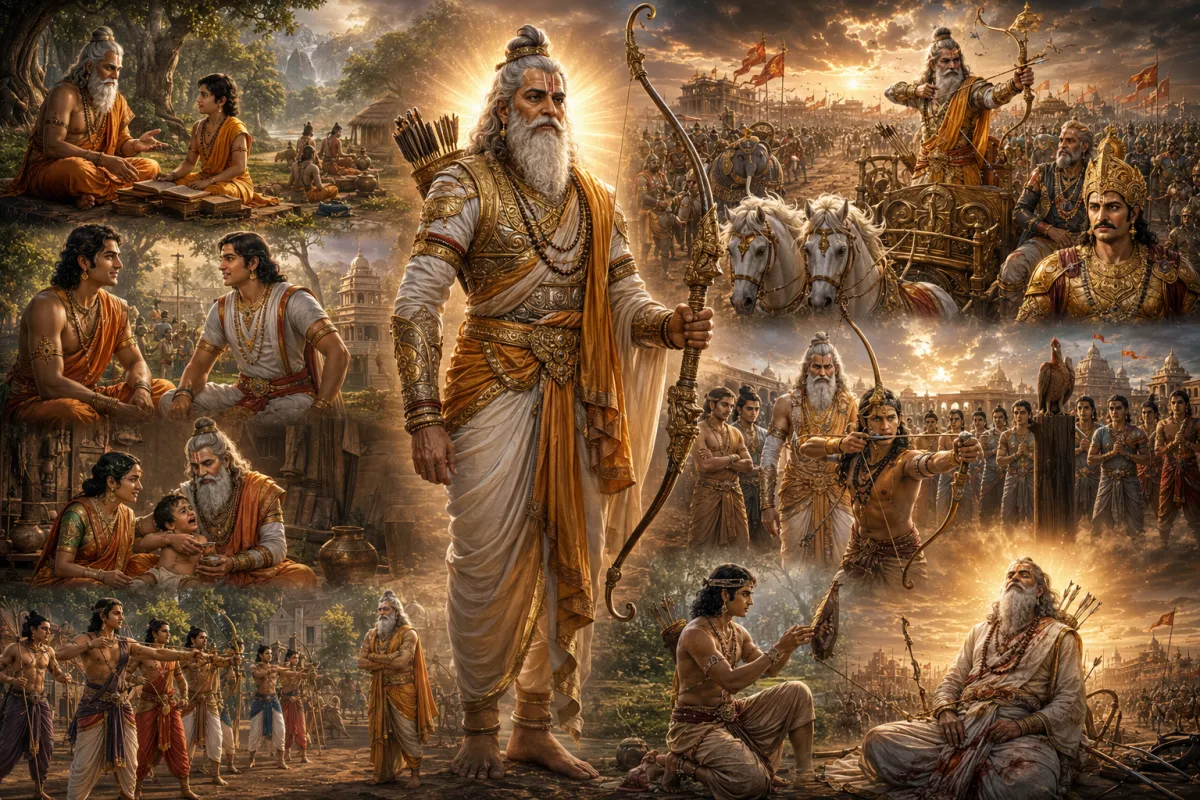
Biography of Acharya Dronacharya: Birth, Family, Education, Martial Arts from Lord Parashurama, and Early Life
Acharya Dronacharya is considered one of the greatest gurus in Indian history and the Mahabharata. He was not only an unparalleled archery master but also a profound scholar of weaponry, warfare strategy, and dharma. He trained numerous princes, including the Pandavas and Kauravas, in the art of warfare. His most distinguished disciple, Arjuna, is regarded as the greatest archer in history.
The life of Acharya Dronacharya is a remarkable example of sacrifice, penance, knowledge, struggle, self-respect, and the guru-shishya tradition. His name appears in every significant episode of the Mahabharata.
In the first part of this article, we will delve into the details of Dronacharya's birth, family, childhood, education, acquisition of divine martial arts from Lord Parashurama, and his early life.
Introduction to Acharya Dronacharya
Acharya Dronacharya was the son of Maharishi Bharadwaj. He was a great Brahmin, an unparalleled archer, a master of divine weapons, and the most renowned guru of the Mahabharata era. He imparted martial arts training to the princes of Hastinapur—the Pandavas and the Kauravas.
His teachings transformed Arjuna, Bhima, Duryodhana, Ashwatthama, Yudhishthira, Nakula, Sahadeva, and many other warriors into great maharathis.
Birth of Dronacharya
According to the Puranas and the Mahabharata, Maharishi Bharadwaj was a great ascetic sage. One day, he saw the celestial nymph Ghrtachi on the banks of the Ganges. He collected the divine essence that arose in his mind in a vessel (drona).
From that divine vessel, a child was born. Since he was born from a vessel named Drona, he was named Drona. Later, he became famous throughout Aryavarta as Acharya Dronacharya.
Why was Dronacharya named Drona?
In Sanskrit, "Drona" means a wooden or earthen pot. The child born from Maharishi Bharadwaj's essence emerged from this vessel, hence he was named Drona.
When he acquired unparalleled knowledge in both scriptures and weaponry and began teaching many princes, he was respectfully addressed as Acharya Dronacharya.
Maharishi Bharadwaj – Dronacharya's Father
Maharishi Bharadwaj is considered one of the Saptarishis (Seven Sages). He was a great scholar of the Vedas, Ayurveda, Dhanurveda, and many other scriptures. His ashram was a major center of learning and penance.
Dronacharya was raised in this ashram, where from childhood he learned the Vedas, scriptures, Brahmacharya, discipline, and the observance of dharma.
Childhood and Early Education
From childhood, Dronacharya was extremely intelligent, curious, and diligent. Along with studying the Vedas, he had a special interest in Dhanurveda, warfare strategy, handling of arms and armor, and military science.
Maharishi Bharadwaj provided him with his initial education. His life in the ashram taught him the importance of restraint, simplicity, penance, and self-control.
Friendship with Prince Drupad
Many princes came to Maharishi Bharadwaj's ashram for education. Among them was Drupad, the son of the King of Panchala.
Drona and Drupad studied, practiced, and spent time together. Their friendship was so deep that Drupad said—
"When I become the king of Panchala, half of my kingdom will be yours."
Dronacharya cherished this promise as a symbol of true friendship. However, in the future, this very friendship became the cause of a significant event in the Mahabharata.
Special Interest in Archery
Dronacharya was not limited to scriptures alone. He had an extraordinary interest in the art of warfare. He would practice archery for hours and learn new combat skills.
All the sages and scholars were amazed by his talent.
Education from Lord Parashurama
As time passed, Dronacharya decided that he would acquire the knowledge of arms and armor from the greatest warrior and guru of that era, Lord Parashurama.
When he reached Parashurama, the latter had already donated most of his wealth. Only divine weapons, arms, and his knowledge remained with him.
Dronacharya humbly stated that he did not seek wealth but knowledge.
Lord Parashurama was extremely pleased with his humility, penance, and worthiness. He imparted to Dronacharya the knowledge of operating divine weapons, including Brahmastra, Agneyastra, Varunastra, Vayuvastra, and many other divine armaments.
Great Master of Divine Arms and Armaments
After receiving education from Lord Parashurama, Dronacharya became the greatest expert in arms and armor of his time. He knew not only how to wield weapons but also how to control and recall them.
For this reason, his position in the Mahabharata war was considered equal to that of maharathis like Bhishma, Karna, and Arjuna.
Personality of Dronacharya
Dronacharya's personality was highly influential. He was a disciplinarian, serious, learned, and a strict guru. For him, education was not just a means to win wars but also the foundation for character building.
He expected complete dedication, discipline, and continuous practice from his disciples.
Confluence of Knowledge and Penance
Dronacharya's life proves that greatness is not attained by birth alone but through knowledge, hard work, and penance. Drona, raised in a simple ashram life, made himself the best guru of his era through his talent and arduous practice.
Biography of Acharya Dronacharya: Marriage to Kripa, Birth of Ashwatthama, Poverty, Insult by King Drupad, and Arrival in Hastinapur
In the early years of his life, Acharya Dronacharya underwent rigorous penance, studied, and acquired knowledge of divine arms and armor from Lord Parashurama. He was unparalleled in knowledge and warfare, but the next phase of his life was filled with struggle, self-respect, and challenges.
In this section, we will learn how Dronacharya got married, how Ashwatthama was born, what difficulties he faced due to poverty, why his childhood friend King Drupad insulted him, and how he became the royal guru of Hastinapur.
Marriage to Kripa
After receiving education from Lord Parashurama, Dronacharya married Kripa. Kripa was the sister of the great warrior and family preceptor Kripacharya. Both Kripacharya and Kripa are considered offspring of Maharishi Sharadvana.
Kripa was extremely virtuous, learned, and devoted to her husband. She supported Dronacharya through every difficult phase of his life.
Birth of Ashwatthama
A short time after their marriage, Dronacharya and Kripa were blessed with a son, whom they named Ashwatthama.
According to the Puranas, at the time of his birth, his cry resembled that of a horse. This is why he was named Ashwatthama.
Ashwatthama was born with immense brilliance, valor, and divine powers. It is believed that he is considered an incarnation of Lord Shiva.
The Difficult Period of Poverty
Although Dronacharya was a great scholar and master of arms and armor, he possessed no kingdom, wealth, or property. He lived a very simple life with his family.
There were many times when his ashram lacked even food and essential supplies. However, he never commercialized his knowledge.
He believed that the purpose of knowledge was to establish dharma, not merely to earn money.
The Incident of Milk
According to a very poignant incident described in the Mahabharata, one day, young Ashwatthama saw other children drinking milk. He also asked his mother for milk.
There was no cow at home, nor was there money to buy milk. Kripa mixed flour with water, made it resemble milk, and gave it to him to drink.
When the other children mocked him, Dronacharya's heart was deeply pained.
He realized that merely possessing knowledge was not enough to support a family. This incident changed the course of his life.
Remembering Old Friend Drupad
Dronacharya remembered the friendship from his gurukul days. He recalled that his friend Drupad had said—
"When I become the king of Panchala, half of my kingdom will be yours."
Seeing the difficult circumstances of his son and family, Dronacharya went to the kingdom of Panchala hoping for help.
Insult by King Drupad
When Dronacharya arrived at the royal court, King Drupad recognized him, but his demeanor had completely changed.
Dronacharya asked for help as an old friend, but Drupad said—
"Friendship exists only between equals. A poor Brahmin and a king can never be friends."
Hearing this, the entire assembly fell silent. Dronacharya's heart was filled with deep anguish.
This insult proved to be the biggest turning point in his life.
Vow of Revenge
As he left the royal court, Dronacharya vowed in his heart that one day he would defeat Drupad and teach him the true meaning of friendship.
This revenge was not for personal ego but for the protection of his insulted self-respect.
Departure for Hastinapur
After the insult from Drupad, Dronacharya arrived in Hastinapur. His brother-in-law, Kripacharya, was already the royal guru there.
Kripacharya welcomed him respectfully and urged him to stay in Hastinapur.
The Famous Well Incident
One day, the princes of Hastinapur were playing and accidentally dropped their ball into a deep well. Despite many attempts, they could not retrieve the ball.
At that moment, Dronacharya, who was passing by, witnessed this scene.
Without entering the well, he retrieved the ball and then the princes' rings using only arrows.
The princes were astonished by this incredible skill.
Meeting with Bhishma Pitamah
When this news reached Bhishma Pitamah, he immediately summoned Dronacharya to the royal palace.
Bhishma, observing his knowledge, humility, and martial prowess, realized that he was the guru who could train the princes of Hastinapur to become excellent warriors.
He requested Dronacharya to become the royal guru of Hastinapur.
Royal Guru of Hastinapur
Dronacharya accepted this responsibility. He was provided with royal honors, an ashram, and all necessary facilities.
His life's struggles began to subside, and a new chapter commenced.
He began imparting training in archery, mace fighting, swordsmanship, spear throwing, chariot driving, and warfare strategy to the Pandavas, Kauravas, and many other princes.
Dronacharya's Teaching Style
Dronacharya did not just teach how to wield weapons. He also taught his disciples discipline, patience, concentration, self-control, and dharma.
He believed that a warrior whose character is not noble can never be a true victor.
Special Attention to Arjuna
Dronacharya quickly recognized that Arjuna possessed extraordinary talent, diligence, and dedication.
He provided Arjuna with extra practice and taught him new combat techniques.
This is why Arjuna later became known as the greatest archer in the world.
Biography of Acharya Dronacharya: Guru of Pandavas and Kauravas, The Story of Making Arjuna the Best Archer, Eklavya, Guru Dakshina, and the Defeat of Drupad
After Acharya Dronacharya became the royal guru of Hastinapur, the most significant chapter of his life began. Now, his task was to train all the princes of the Kuru dynasty to become excellent warriors. Among his disciples were Yudhishthira, Bhima, Arjuna, Nakula, Sahadeva, Duryodhana, Dushasana, Ashwatthama, and many other princes.
Dronacharya did not just teach how to use arms and armor; he also imparted lessons on discipline, concentration, patience, restraint, and dharma. The impact of his teachings was so profound that his disciples later became great maharathis of the Mahabharata.
Beginning of Education for Pandavas and Kauravas
In Hastinapur, Dronacharya established a large gurukul. All the princes received education under the same rules. No prince was shown any favoritism.
Waking up at Brahma Muhurta (dawn), physical exercises, meditation, scriptural studies, arms and armor training, chariot driving, mace fighting, swordsmanship, spear throwing, and warfare strategy—all these subjects were practiced regularly.
Yudhishthira – Expert in Dharma and Spear
Yudhishthira was truthful and calm. Dronacharya taught him spear throwing, warfare strategy, and royal dharma. He was more interested in justice and policy than in war.
Bhima and Duryodhana – Maharathis in Mace Fighting
Both Bhima and Duryodhana were exceptionally strong. Dronacharya provided them with special training in mace fighting.
During practice, there were often intense competitions between the two. Dronacharya always taught them to maintain restraint and decorum.
Arjuna – Unparalleled Talent
Dronacharya quickly recognized that Arjuna possessed extraordinary concentration, discipline, and an amazing capacity to learn. Arjuna practiced day and night and absorbed every lesson with complete focus.
Dronacharya decided that he would make Arjuna the greatest archer in the world.
The Incident of Practicing in Darkness
One day, while eating, the lamp suddenly went out. Arjuna realized that his hand could eat even without seeing. At that moment, he thought that if practice is done continuously, one can hit a target even in darkness.
From that day onwards, Arjuna began practicing at night as well.
When Dronacharya witnessed this, he was extremely pleased and said—
"Arjuna! Your dedication will make you the greatest archer in the world."
The Test of the Bird's Eye
One day, Dronacharya decided to test the concentration of all his disciples. He placed an artificial bird on a tree and ordered all the princes to aim at its eye.
First, Yudhishthira came. Dronacharya asked—
"What do you see?"
Yudhishthira replied—
"Gurudev! I see the tree, the branches, the bird, and its eye."
Dronacharya asked him to step back.
Similarly, Bhima, Duryodhana, and others gave different answers.
Finally, Arjuna came.
Dronacharya asked—
"Arjuna, what do you see?"
Arjuna replied—
"Gurudev! I see only the bird's eye."
Dronacharya immediately ordered him to shoot. Arjuna's arrow hit the bird's eye directly.
Dronacharya declared that Arjuna was worthy of becoming the world's greatest archer.
The Story of Eklavya
Eklavya, the son of Nishadraj Hiranyadhanu, who lived in the forest, also wished to learn archery from Dronacharya. He reached Hastinapur and humbly requested him to be his guru.
Dronacharya was the royal guru of the princes at that time. The reasons for this incident are described differently in various traditions, hence this event has multiple interpretations.
Eklavya returned, made a clay statue of Dronacharya, and began practicing himself, considering it his guru. Through his dedication and continuous practice, he became a highly skilled archer.
The Incident of the Barking Dog
One day, the Pandavas went into the forest. There, they saw a dog with seven arrows lodged in its mouth in such a way that it could not bark without being injured.
Everyone was astonished by such an incredible shot.
At some distance, they saw Eklavya. He introduced himself as Dronacharya's disciple.
Guru Dakshina
When Dronacharya learned of Eklavya's extraordinary talent, he asked for Guru Dakshina (a gift to the teacher).
Eklavya said with great reverence—
"Gurudev! Whatever command you give, I will accept it with pleasure."
Dronacharya asked for the thumb of his right hand.
Eklavya, without any hesitation, cut off his thumb and offered it at his guru's feet.
This incident is a very famous example of devotion to the guru in Indian tradition. Modern scholars also interpret this event from various historical, social, and ethical perspectives.
Making Arjuna the Best Archer
Dronacharya taught Arjuna the knowledge of divine weapons, warfare strategy, hitting moving targets, night combat, chariot driving, and practiced many special techniques.
Arjuna followed every instruction of his guru and soon became the greatest archer in all of Aryavarta.
The Demand for Guru Dakshina
After the completion of his education, Dronacharya demanded Guru Dakshina from all his disciples. He said that if they truly wanted to repay their guru's debt, they must defeat and present before him the King of Panchala, King Drupad.
This was the same Drupad who had insulted Dronacharya.
Failure of the Kauravas
First, the Kaurava army, led by Duryodhana, marched to attack Panchala. However, Drupad's army defeated them.
The Kauravas had to return defeated.
Victory of Arjuna
After this, Arjuna, Bhima, and other Pandavas reached the battlefield. Arjuna, with his incredible valor, defeated the Panchala army.
He captured King Drupad alive and presented him before Dronacharya.
Reunion of Dronacharya and Drupad
Dronacharya said to Drupad—
"Now we are both equals. You said that friendship exists only between equals. Today, I have defeated you in battle."
After this, Dronacharya kept half of Drupad's kingdom and returned the other half to him.
He proved that his objective was not just revenge but the restoration of his self-respect.
Drupad's Resolve
Drupad could never forget this defeat. He performed a yajna (ritual sacrifice) from which Dhrishtadyumna and Draupadi were born.
Dhrishtadyumna was specifically believed to have been born with the purpose of killing Dronacharya. Later, this prophecy proved true in the Mahabharata war.
Ideal of Dronacharya
Dronacharya did not just expect martial skills from his disciples. He wanted every warrior to uphold dharma, discipline, restraint, and devotion to the guru.
The disciples who emerged from his gurukul later became the most famous warriors in Indian history.
Biography of Acharya Dronacharya: Role in the Mahabharata War, Chakravyuha, Abhimanyu's Death, Demise, Life Lessons, and Conclusion
Acharya Dronacharya was not only the guru of the Pandavas and Kauravas but also one of the most formidable maharathis in the Mahabharata war. His knowledge, command over divine arms and armor, and his exceptional understanding of warfare strategy made him the greatest commander of that era.
In the Mahabharata war, he fulfilled his duty by siding with the Kaurava faction, as he was the royal guru of Hastinapur and considered loyalty to the kingdom his dharma. Although his heart was filled with affection for the Pandavas, he never compromised on his responsibilities.
In this section, we will delve into Dronacharya's role in the Mahabharata war, the formation of the Chakravyuha, Abhimanyu's death, his demise, the lessons learned from his life, and his significance in modern life.
Role of Dronacharya in the Mahabharata War
When the Mahabharata war began at Kurukshetra, Dronacharya was among the principal maharathis of the Kaurava army. For the first ten days, Bhishma Pitamah was the commander-in-chief, while Dronacharya was strengthening the Kaurava army with his divine weapons and strategies on the battlefield.
He was well acquainted with the fighting styles of Arjuna, Bhima, and other Pandavas, as he himself was their guru. Therefore, his strategies proved to be highly effective.
Became Commander of the Kaurava Army
On the tenth day, after Bhishma Pitamah took to the bed of arrows, Duryodhana appointed Dronacharya as the commander-in-chief of the Kaurava army.
Dronacharya accepted this responsibility and devised many complex military plans to give a new direction to the war. His objective was to somehow capture Yudhishthira, thereby bringing the war to a swift end.
Formation of the Chakravyuha
On the thirteenth day of the Mahabharata, Dronacharya formed the famous Chakravyuha. It was considered one of the most difficult and impenetrable formations of that time.
Dronacharya knew that Arjuna could break the Chakravyuha. Therefore, he devised a plan to keep Arjuna engaged at the other end of the battlefield.
Due to this plan, only Abhimanyu among the Pandava army could enter the Chakravyuha.
Heroic Battle of Abhimanyu
Abhimanyu, the son of Arjuna, entered the Chakravyuha alone. He knew how to enter the formation but did not know the complete method of exiting.
Despite this, he displayed immense courage and faced many maharathis alone.
During the battle, Dronacharya, Karna, Kripacharya, Ashwatthama, Kritavarma, and other warriors attempted to stop Abhimanyu. Finally, violating the rules of war, many maharathis launched a combined attack, leading to Abhimanyu's heroic demise.
This event is considered one of the most poignant episodes in the Mahabharata.
Dronacharya and Arjuna
Guru and disciple faced each other on the battlefield. Dronacharya was well aware of Arjuna's talent, and Arjuna held his guru in high esteem.
On several occasions, Arjuna expressed respect towards Dronacharya, and Dronacharya, in turn, praised Arjuna's valor.
This war was not just a conflict of weapons but also of duty and emotions.
The Plan with Ashwatthama's Name
Defeating Dronacharya was almost impossible. He was inflicting heavy casualties on the Pandava army by using divine weapons.
Lord Krishna realized that as long as Dronacharya wielded weapons, the war would be difficult to end.
Bhima killed an elephant named Ashwatthama on the battlefield and shouted loudly—
"Ashwatthama is dead!"
Dronacharya did not believe it. To ascertain the truth, he asked Dharmaraj Yudhishthira, as he knew Yudhishthira never lied.
Yudhishthira replied—
"Ashwatthama Hatah..." "Naro va kunjaro va" (Man or elephant).
It is said that the final words were drowned out by the sound of conches. Dronacharya only heard the first part and believed that his son Ashwatthama was dead.
Death of Dronacharya
Overwhelmed with grief at the loss of his son, Dronacharya laid down his arms and armor and became engrossed in meditation.
At that moment, Dhrishtadyumna, the prince of Panchala, seized the opportunity and beheaded him.
Dhrishtadyumna is believed to have been born specifically with the purpose of killing Dronacharya. Thus, a prophecy made years ago was fulfilled.
Was Dronacharya's Death Justified?
Scholars still debate Dronacharya's death. Some consider it a necessary decision in warfare strategy, while others deem it against the ideals of war.
The Mahabharata itself shows that the circumstances of war often lead to decisions that are not easy to evaluate ethically. Therefore, this episode is understood from various perspectives.
Impact on Ashwatthama
Ashwatthama was enraged by his father's death. After the war ended, he attacked the Pandava camp at night and killed Dhrishtadyumna and the Upapandavas.
This incident made the final chapters of the Mahabharata even more tragic.
Personality of Acharya Dronacharya
- Great Archery Master
- Unparalleled Master of Arms and Armaments
- Disciplinarian Guru
- Expert in Warfare Strategy
- Duty-Bound Brahmin
- Excellent Teacher
- Self-Respecting Personality
- Symbol of Simplicity and Penance
20 Lessons from Dronacharya's Life
- Knowledge is the greatest asset.
- Respect for the guru is the foundation of life.
- Continuous practice is the key to success.
- Discipline is the first step to greatness.
- Talent development comes through hard work.
- Fulfilling duty is above circumstances.
- Ego destroys friendship.
- Protecting self-respect is essential.
- A great teacher is one who can recognize a disciple's potential.
- Concentration is the root mantra of success.
- Knowledge should be used for dharma.
- Decisions made in anger can lead to tragic consequences.
- One should maintain patience in life.
- There is no substitute for hard work.
- Ethical decisions are not always simple.
- Wisdom is essential in leadership.
- Humility is as important as knowledge.
- Circumstances change, character does not.
- The guru-shishya relationship is based on trust.
- Balancing dharma and duty is life's greatest test.
Interesting Facts Related to Acharya Dronacharya
- He was the son of Maharishi Bharadwaj.
- His name became Drona because he was born from a drona (vessel).
- Lord Parashurama was his guru.
- He was the royal guru to both the Pandavas and the Kauravas.
- Arjuna is considered his most beloved and best disciple.
- He created the Chakravyuha formation.
- His son's name was Ashwatthama.
- Dhrishtadyumna killed him.
- His life is an invaluable example of the guru-shishya tradition.
- His place among the greatest teachers of the Mahabharata is considered supreme.
Conclusion
The life of Acharya Dronacharya is not just the story of a great warrior or guru, but an inspiring history of knowledge, discipline, self-respect, and duty. He did not just teach his disciples how to fight but also the art of living life.
His life contained struggle, honor, difficult decisions, and circumstances from which lessons on leadership, education, and ethics can still be learned today. His contribution to the Mahabharata will forever be immortal, and he will always be remembered among the greatest gurus of Indian culture.
॥ Gurur Brahma Gurur Vishnuḥ Gurur Devo Maheshvaraḥ ।
Guruḥ Sākṣāt Parabrahm Tasmāi Śrīgurave Namaḥ ॥
Today's Panchang 14 September 2026
For auspicious times, choghadiya, horoscope and planetary positions
Related Articles
What are the 12 Jyotirlingas? Significance and Stories of Lord Shiva's 12 Jyotirlingas
हिंदू धर्म में भगवान शिव के 12 ज्योतिर्लिंग अत्यंत पवित्र और महत्वपूर्ण तीर्थस्थल माने जाते हैं। धार्मिक मान्यताओं के अनुसार, इन स्थानों पर भगवान शिव स्वयं ज्योतिर्लिंग स्वरूप में विराजमान हैं। सोमनाथ से लेकर रामेश्वरम तक प्रत्येक ज्योतिर्लिंग की अपनी अनोखी पौराणिक कथा, धार्मिक मान्यता और आध्यात्मिक विशेषता है। इस लेख में जानें 12 ज्योतिर्लिंगों के नाम, स्थान, पौराणिक कथाएं, धार्मिक महत्व और इनके दर्शन से जुड़ी महत्वपूर्ण जानकारी।
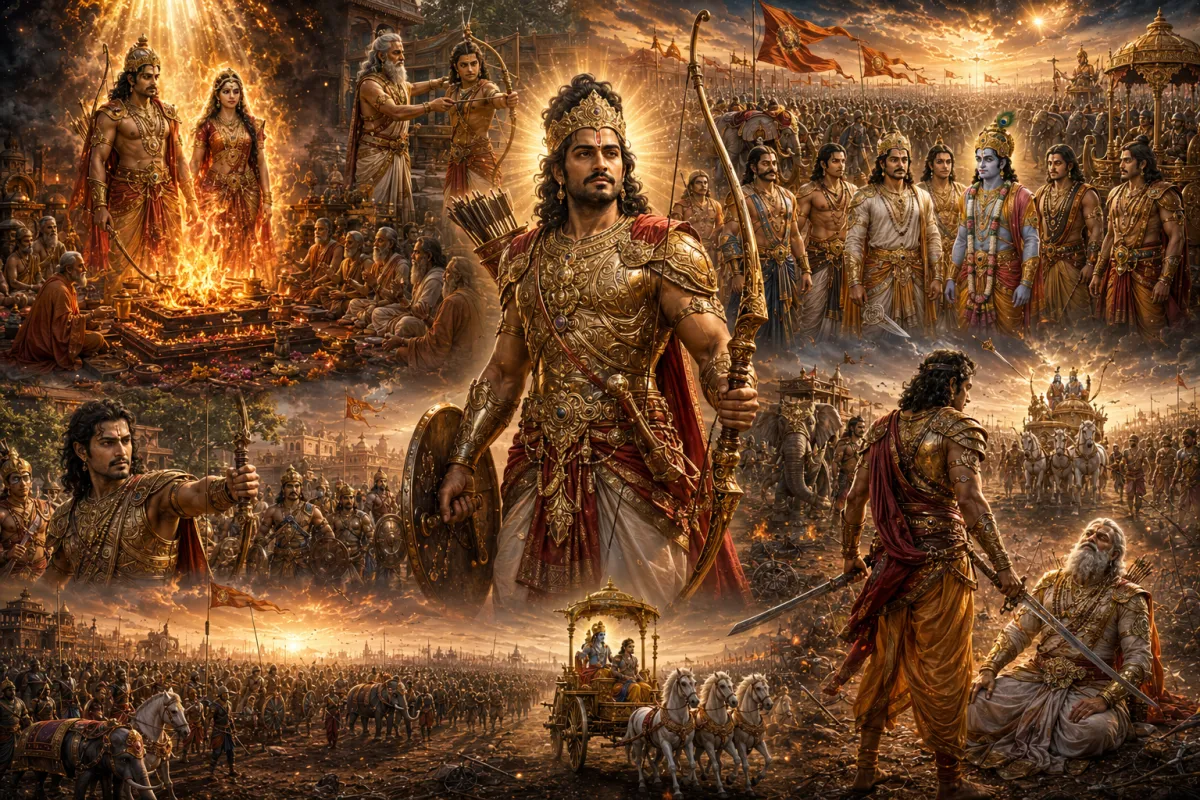
Life Introduction of Dhrishtadyumna: Birth, Killing of Dronacharya, Role in Mahabharata War, Death, and Interesting Facts
धृष्टद्युम्न महाभारत के महान योद्धा, पांचाल नरेश द्रुपद के पुत्र और पांडव सेना के सेनापति थे। इस लेख में उनके दिव्य जन्म, द्रोणाचार्य वध, महाभारत युद्ध में योगदान, मृत्यु, परिवार और उनसे मिलने वाली प्रेरणादायक शिक्षाओं का विस्तृत वर्णन पढ़ें।
Significance of Sunday and Sun Worship
रविवार का दिन सूर्य देव को समर्पित है। मान्यता है कि अगर रविवार के दिन सूर्य देव की श्रद्धापूर्वक पूजा-अर्चना की जाए तो मनुष्य के जीवन में सुख-समृद्धि और धन-संपत्ति…
Naag Panchami Katha
प्राचीन काल में एक सेठजी के सात पुत्र थे। सातों के विवाह हो चुके थे। सबसे छोटे पुत्र की पत्नी श्रेष्ठ चरित्र की विदूषी और सुशील थी, परंतु उसके भाई…
Vat Savitri Vrat Katha
वट सावित्री व्रत कथा – वट सावित्री व्रत ज्येष्ठ मास की अमावस्या के साथ आज मनाया जा रहा है। आज सुहागिन महिलाएं व्रत रखने के साथ…