
Life Introduction of Dhrishtadyumna: Birth, Killing of Dronacharya, Role in Mahabharata War, Death, and Interesting Facts
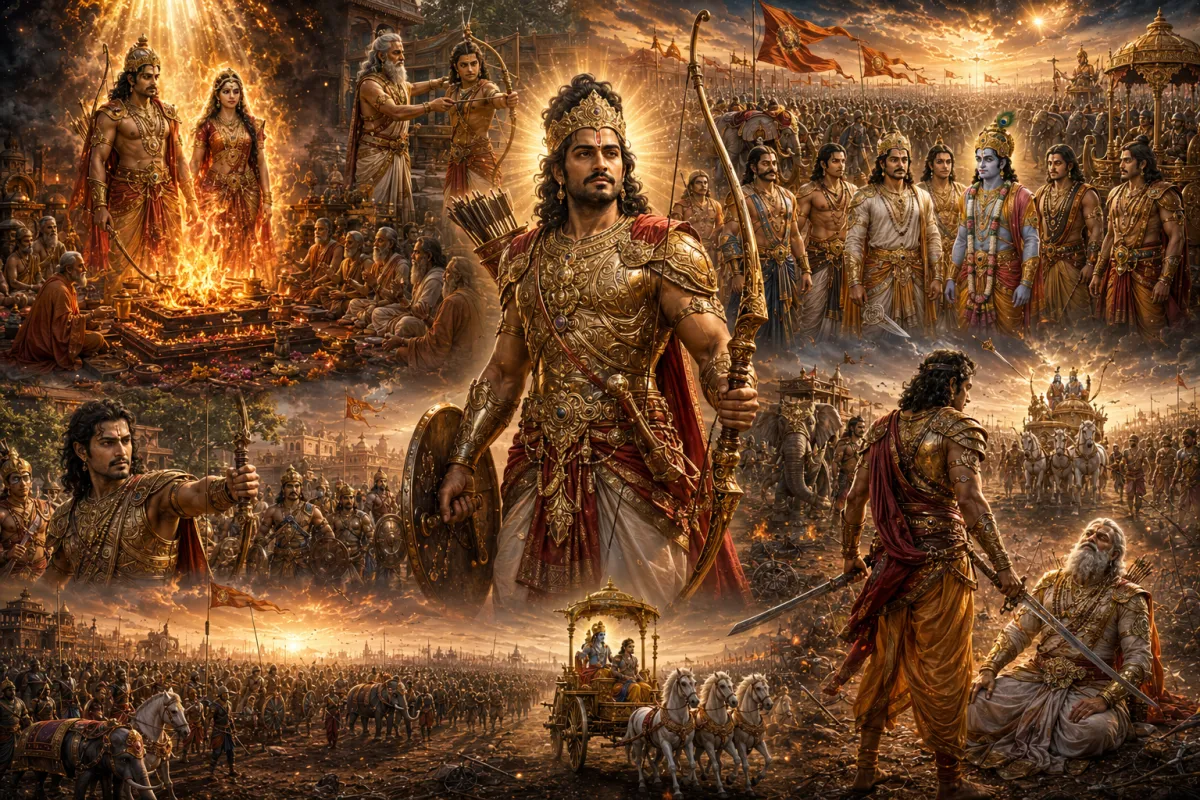
Life Introduction of Dhrishtadyumna: Birth, King Drupad, Enmity with Dronacharya, Story of Divine Appearance from the Fire Altar
Dhrishtadyumna was one of the most valiant and mysterious warriors of the Mahabharata. He was the son of the Panchala king King Drupad, the elder brother of Draupadi, and the first commander-in-chief of the Pandava army. His birth was not like that of ordinary humans; rather, he manifested divinely from the fire of a sacrifice.
According to the Mahabharata, his birth occurred for a specific purpose—to slay Acharya Dronacharya. This is why Dhrishtadyumna's life was intertwined with destiny, revenge, dharma, and war from its very beginning.
In the first part of this article, we will learn the detailed story of Dhrishtadyumna's birth, his family, the enmity between King Drupad and Dronacharya, the Putreshti Yajna, and his divine manifestation from the fire altar.
Who was Dhrishtadyumna?
Dhrishtadyumna was one of the prominent characters of the Mahabharata. He was the crown prince of the Panchala kingdom, the brother of Draupadi, and the commander-in-chief of the Pandava army in the Mahabharata war. He was extremely skilled in warfare, archery, and strategy.
Although his life was relatively short, his contribution to the history of the Mahabharata is considered extremely significant. If Dhrishtadyumna had not existed, the slaying of Dronacharya would not have been considered possible.
Meaning of the Name Dhrishtadyumna
The word "Dhrishtadyumna" is formed from two Sanskrit words—
- Dhrishta – Courageous, fearless, valiant.
- Dyumna – Radiance, glory, divine power, and splendor.
Thus, Dhrishtadyumna is one who is endowed with unique radiance, courage, and martial prowess. True to his name, his entire life was a symbol of valor and martial skill.
Introduction to King Drupad
Dhrishtadyumna's father, King Drupad, was a powerful and respected king of the Panchala kingdom. In his youth, he received education at the ashram of Maharishi Bharadwaja. There, he befriended a Brahmin boy named Drona, who later became Acharya Dronacharya.
They shared a deep friendship. Drupad promised Drona that after becoming king, he would share half of his kingdom with him.
However, as time passed, circumstances changed, and this friendship turned into bitter enmity.
Enmity Between Dronacharya and Drupad
After acquiring knowledge of divine weapons from Lord Parashurama, Dronacharya was living in poverty, struggling to support his family. He remembered his old friend Drupad's promise and went to Panchala hoping for help.
However, King Drupad insulted him in the royal court, saying—
"Friendship exists only between equals in status and strength. A king and a poor Brahmin cannot be friends."
This insult deeply wounded Dronacharya's heart. Later, when he became the royal preceptor of Hastinapur, he had his disciple Arjuna defeat and capture Drupad.
Dronacharya took possession of half of Drupad's kingdom and returned the remaining half to him.
Although Drupad was freed, the fire of humiliation in his heart burned even brighter.
King Drupad's Revenge
After his defeat by Dronacharya, King Drupad vowed to obtain a son who could slay Dronacharya in the future.
He consulted many sages and finally sought refuge with the great ascetics Yaja and Upayaja.
King Drupad requested them to perform a special Putreshti Yajna for the purpose of obtaining a son and slaying Dronacharya.
Putreshti Yajna
Sages Yaja and Upayaja arranged a grand sacrifice according to Vedic rituals. The yajna was completed over many days with Vedic mantras, oblations, and penance.
In the final stage of the yajna, a divine light emerged from the fire altar. All the assembled people were astonished by this wondrous sight.
Divine Birth of Dhrishtadyumna from the Fire Altar
According to the Mahabharata, a radiant, divine, and fully grown young prince emerged from the sacrificial fire. He was clad in golden armor, holding a divine bow and sword in his hands. He appeared ready for battle from the moment of his birth.
His radiance illuminated the entire sacrificial hall. All the sages, gods, and assembled kings were amazed by this divine event.
This divine prince later came to be known as Dhrishtadyumna.
Celestial Announcement
As soon as Dhrishtadyumna appeared, a divine voice was heard from the sky—
"This brave prince will slay Acharya Dronacharya and bring glory to the Panchala kingdom."
This prophecy made it clear that Dhrishtadyumna's birth was no ordinary event but part of a divine plan.
Divine Birth of Draupadi
A few moments after Dhrishtadyumna's appearance, an extremely beautiful maiden also emerged from the same sacrificial fire. She later became famous as Draupadi or Krishna.
Thus, both Dhrishtadyumna and Draupadi, brother and sister, manifested divinely from the sacrificial fire. Therefore, they are also called Agnij (born of fire).
Divine Qualities and Future
From birth, Dhrishtadyumna was endowed with extraordinary radiance, courage, and leadership abilities. The sages prophesied that he would become a great warrior and play a significant role in establishing dharma.
His birth's purpose was not merely revenge but also to aid the side of dharma in the Mahabharata war.
Celebration in the Panchala Kingdom
The divine birth of Dhrishtadyumna and Draupadi was celebrated with great festivity throughout the Panchala kingdom. The city was decorated, sacrifices were performed, alms were given to Brahmins, and the subjects welcomed their future crown prince.
King Drupad was confident that his son would one day defeat Dronacharya and avenge his insult.
Was Dhrishtadyumna Born Solely for Revenge?
Although his birth in the Mahabharata is described as being for the purpose of slaying Dronacharya, his personality was not limited to revenge. He was a capable prince, a skilled commander, a righteous warrior, and a trusted ally of the Pandavas.
In the Mahabharata war, he led the Pandava army and displayed his valor in many significant battles.
Life Introduction of Dhrishtadyumna: Education, Arms and Ammunition from Dronacharya, Draupadi's Swayamvara, Relationship with the Pandavas, and the Story of Becoming Commander-in-Chief of the Pandava Army
Dhrishtadyumna's birth from the sacrificial fire had a single purpose—to slay Acharya Dronacharya. However, one of the most astonishing events of the Mahabharata is that the very Dronacharya, whose slaying was the reason for his birth, imparted the knowledge of arms and ammunition to him.
This episode is one of the deepest philosophical messages of the Mahabharata, where a guru imparts complete education to his disciple without regard for his personal future, and the disciple moves towards his predetermined life purpose.
In this section, we will provide a detailed account of Dhrishtadyumna's childhood, education, martial arts received from Dronacharya, his role in Draupadi's Swayamvara, his relationship with the Pandavas, and the story of him becoming the commander-in-chief of the Pandava army.
Childhood as the Crown Prince of Panchala
After manifesting divinely from the sacrificial fire, Dhrishtadyumna was raised in the royal palace of the Panchala kingdom. King Drupad nurtured him with great affection and instilled in him from childhood the belief that he would become a great warrior in the future.
From birth, Dhrishtadyumna displayed courage, leadership abilities, and a special interest in martial arts. He excelled over other princes in horsemanship, chariot driving, swordsmanship, and archery.
Did Dronacharya Know the Prophecy?
According to the Mahabharata, it was a well-known prophecy that Dhrishtadyumna would later slay Dronacharya. Dronacharya was also aware of this prophecy.
Yet, when Dhrishtadyumna arrived to receive education from him, he accepted him as a disciple.
This episode highlights Dronacharya's impartial nature as a guru. He placed his duty above his personal interests and made no distinctions.
Arms and Ammunition from Dronacharya
Dhrishtadyumna received education in archery, mace fighting, swordsmanship, spear throwing, chariot driving, and warfare strategy from Acharya Dronacharya in Hastinapur.
Dronacharya imparted to him the same knowledge that he gave to other princes. He never attempted to limit Dhrishtadyumna's talent.
This is why Dhrishtadyumna was later counted among the great warriors of the Mahabharata.
The Unique Relationship Between Guru and Disciple
The relationship between Dhrishtadyumna and Dronacharya was extraordinary. The guru knew that this disciple would eventually end his life, and the disciple was also aware of his birth's purpose.
Yet, both adhered to the principles of education and respect.
This episode is considered a unique example of the Indian guru-shishya tradition, where knowledge was placed above any personal animosity.
Dhrishtadyumna's Combat Training
Dhrishtadyumna studied not only archery but the entire science of warfare. He became proficient in commanding large armies, forming battle formations, leading soldiers, and making quick decisions on the battlefield.
King Drupad and all the prominent warriors of Panchala were extremely pleased with his leadership abilities.
Draupadi's Elder Brother
Dhrishtadyumna was extremely affectionate towards his sister Draupadi. Both were born from the same sacrificial fire, so they shared a special bond.
Dhrishtadyumna was always ready to protect Draupadi's honor and safety.
Role in Draupadi's Swayamvara
When King Drupad organized Draupadi's Swayamvara, Dhrishtadyumna took charge of the entire arrangement. He announced the conditions of the Swayamvara and welcomed all the kings.
The challenge in the Swayamvara was to hit the eye of a rotating fish by looking at its reflection in the water below.
Many great warriors, including Karna, failed to succeed in this test. Finally, Arjuna, disguised as a Brahmin, hit the target and won Draupadi's Swayamvara.
Identification of the Pandavas
After the Swayamvara, Dhrishtadyumna suspected that these could not be ordinary Brahmins. He secretly followed them and observed that they were extremely disciplined, brave, and possessed royal demeanor.
When he learned that they were indeed the Pandavas, he conveyed this news to King Drupad.
Drupad was overjoyed by this news and accepted Draupadi's marriage to the Pandavas.
Relationship with the Pandavas
After Draupadi's marriage, a familial relationship was established between Dhrishtadyumna and the Pandavas. He developed close ties, especially with Arjuna and Bhima.
He always supported the side of dharma and stood against injustice towards the Pandavas.
Alliance Between Indraprastha and Panchala
After Draupadi's marriage, a strong political and familial alliance was established between Panchala and Indraprastha.
Dhrishtadyumna was one of the main pillars of this alliance. He provided military and political support to the Pandavas on many occasions.
The Dice Game and Dhrishtadyumna
When Duryodhana and Shakuni snatched the Pandavas' kingdom through the dice game and Draupadi was insulted, Dhrishtadyumna became extremely enraged.
Although he was not present in that assembly, after this incident, he resolved that unrighteousness would surely be ended.
Support During Exile
During the Pandavas' exile, Dhrishtadyumna and the Panchala kingdom maintained their support for them.
They made it clear on many occasions that if a war occurred between dharma and adharma, the Panchala kingdom would stand with dharma.
Preparation for the Mahabharata War
When Lord Krishna's peace efforts failed and the Mahabharata war became inevitable, all allied kingdoms joined their armies with the Pandavas.
The vast army of Panchala was led by Dhrishtadyumna himself.
Why Was He Chosen as Commander-in-Chief of the Pandava Army?
Before the Mahabharata war began, the most important question before the Pandavas was—who would lead the seven Akshauhini army?
After deliberation by Lord Krishna, Yudhishthira, and other prominent warriors, Dhrishtadyumna was appointed commander-in-chief.
There were several reasons for this—
- He was an excellent strategist.
- He was capable of leading a vast army.
- The army of Panchala had complete faith in him.
- His birth itself was for the purpose of protecting dharma.
- He was familiar with Dronacharya's fighting style.
Thus, Dhrishtadyumna officially became the first commander-in-chief of the Pandava army.
Krishna's Guidance Before the War
Before the war began, Dhrishtadyumna held detailed discussions on warfare strategy with Lord Krishna and Yudhishthira.
Krishna advised him to fight with dharma, restraint, and proper strategy.
Dhrishtadyumna vowed to dedicate his all to the protection of dharma.
Life Introduction of Dhrishtadyumna: Role in the Mahabharata War, Leadership of the Pandava Army, Slaying of Dronacharya, and Marvelous Prowess
Dhrishtadyumna's entire life was dedicated to the Mahabharata war. He was born from the sacrificial fire, received education from Acharya Dronacharya himself, and ultimately became the commander-in-chief of the Pandava army in that great war.
During the eighteen days of the Mahabharata war, Dhrishtadyumna displayed unparalleled leadership, valor, and martial skill. He faced many great warriors, successfully led the Pandava army, and ultimately fulfilled his birth's purpose by slaying Acharya Dronacharya.
In this section, we will learn in detail about Dhrishtadyumna's role in the Mahabharata war, his major battles, the Chakravyuha, the strategy after Abhimanyu's death, and the complete story of Dronacharya's slaying.
The Beginning of the Mahabharata War
When all of Lord Krishna's peace efforts failed, the great war of Mahabharata began on the battlefield of Kurukshetra. The Pandavas had an army of seven Akshauhinis, while the Kauravas had eleven Akshauhinis.
Dhrishtadyumna was entrusted with the leadership of the Pandava army. This was a testament to his courage, strategy, and leadership abilities.
First Commander-in-Chief of the Pandava Army
Before the war began, Dhrishtadyumna organized the entire army into various formations. He assigned positions according to the capabilities of each great warrior and established coordination with Arjuna, Bhima, Satyaki, Shikhandi, Drupad, and other warriors.
His strategy was not merely to win the war but also to establish dharma.
The First Ten Days of the War
For the first ten days of the Mahabharata war, Bhishma Pitamaha led the Kaurava army. Bhishma's combat prowess was so formidable that the Pandava army suffered heavy losses.
Dhrishtadyumna faced Bhishma many times, but due to Bhishma's experience and divine weapons, he did not achieve success.
Nevertheless, he never let the morale of the Pandava army weaken.
After Bhishma's Fall
On the tenth day, with the help of Shikhandi and Arjuna, Bhishma Pitamaha lay on a bed of arrows. After this, Duryodhana appointed Acharya Dronacharya as the new commander-in-chief of the Kaurava army.
Now, the most difficult phase of the war began, as Dronacharya was not only a great warrior but also well-acquainted with the Pandavas' fighting style.
Disciple Against Guru
Dhrishtadyumna knew that he was born to slay Dronacharya. On the other hand, Dronacharya was also aware of this prophecy.
Yet, both fought on the battlefield according to their respective duties.
This is a very poignant episode of the Mahabharata, where both guru and disciple were fighting according to dharma and their responsibilities.
Chakravyuha and Warfare Strategy
On the thirteenth day, Dronacharya formed the famous Chakravyuha. This was an extremely complex battle formation, which only a few great warriors knew how to penetrate.
On that day, Arjuna was engaged on another front of the battlefield. As a result, Abhimanyu had to enter the Chakravyuha alone.
Dhrishtadyumna, leading the Pandava army, attempted to break the formation, but Jayadratha prevented other Pandava warriors from entering.
After Abhimanyu's Death
After Abhimanyu attained martyrdom, the Pandava army was filled with grief and anger. Dhrishtadyumna rallied the army's morale and devised a new strategy for the next day's battle.
He, along with Arjuna, Bhima, Satyaki, and other warriors, prepared to face Dronacharya's war plan.
Dronacharya's Marvelous Prowess
From the eleventh to the fifteenth day, Dronacharya inflicted heavy damage on the Pandava army with his divine weapons and combat skills.
No warrior could stand against him for long. He repeatedly attempted to capture Yudhishthira.
Dhrishtadyumna faced him many times, but Dronacharya's combat ability was unparalleled.
Why Was It Necessary to Stop Dronacharya?
Lord Krishna realized that as long as Dronacharya wielded weapons, it would be extremely difficult for the Pandavas to achieve victory.
It was necessary to remove Dronacharya from the battlefield to give the war a decisive turn.
The Plan of the Name Ashwatthama
According to the strategy, Bhima slew an elephant named Ashwatthama and loudly announced—
"Ashwatthama is dead!"
Dronacharya did not believe this. He asked Dharmaraj Yudhishthira for the truth.
Yudhishthira replied—
"Ashwatthama Hatah..." "Naro va Kunjaro va" (Man or elephant).
According to the narrative, the final words were drowned out by the sound of conch shells. Dronacharya only heard that "Ashwatthama is dead" and fell into deep sorrow.
Dronacharya's Laying Down of Arms
Upon hearing the news of his son's demise, Dronacharya's mind became detached from the war. He laid down his arms and sat on his chariot, engrossed in meditation.
This was a very decisive moment on the battlefield.
Slaying of Dronacharya by Dhrishtadyumna
According to the Mahabharata, at that very moment, Dhrishtadyumna descended from his chariot and approached Dronacharya.
Dhrishtadyumna, remembering his birth's purpose, slew the meditating Dronacharya.
There are some variations in the descriptions of this event in different versions, but according to the widely accepted tradition, Dronacharya met his end at the hands of Dhrishtadyumna.
Thus, the celestial announcement made during the yajna proved true.
Was Dhrishtadyumna's Action Justified?
The slaying of Dronacharya is one of the most discussed episodes of the Mahabharata. Some traditions consider it a necessity of righteous warfare, while some scholars question it in the context of the ideals of war.
The Mahabharata itself, like many other events, presents this episode as one of complex ethical situations, where duty, vows, and war strategy clash.
Dhrishtadyumna's Prowess in the War
After the slaying of Dronacharya, Dhrishtadyumna continued to lead the Pandava army. He fought bravely against the Kaurava army until the final days of the war.
On the eighteenth day, with Duryodhana's defeat, the victory of the Pandavas was assured. Dharma was established, and unrighteousness was vanquished.
Symbol of Dharma and Leadership
Dhrishtadyumna was not just a brave warrior but also a skilled commander. He maintained the morale of his soldiers at every stage of the war and set an excellent example of leadership even in difficult circumstances.
His personality exhibited a wonderful balance of courage, patience, strategy, and devotion to duty.
Life Introduction of Dhrishtadyumna: Death, Ashwatthama's Revenge, Family, Interesting Facts, Life Lessons, and Conclusion
Dhrishtadyumna's entire life was connected to the righteous war of the Mahabharata. He was born from the sacrificial fire, took revenge for his father King Drupad's insult, became the first commander-in-chief of the Pandava army, and finally fulfilled his birth's purpose by slaying Acharya Dronacharya.
However, his life journey did not end after Dronacharya's slaying. Dhrishtadyumna's role in the final days of the Mahabharata war and the events that followed was extremely significant. Ultimately, he too had to face a tragic death.
In this final section, we will learn in detail about Dhrishtadyumna's death, Ashwatthama's revenge, his family, interesting facts, lessons from his life, and the historical significance of his personality.
Victory in the Mahabharata War
Even after Dronacharya's slaying, Dhrishtadyumna continued to lead the Pandava army. He fought bravely against the Kaurava army until the last days of the war.
On the eighteenth day, with Duryodhana's defeat, the victory of the Pandavas was assured. Dharma was established, and unrighteousness was vanquished.
After the war ended, all the warriors were resting in the Pandava camp. No one anticipated that another horrific event was about to unfold.
Ashwatthama's Revenge
Ashwatthama was extremely enraged by the death of his father, Acharya Dronacharya. He considered Dhrishtadyumna his father's killer and wanted revenge at any cost.
After Duryodhana's death, Ashwatthama, Kripacharya, and Kritavarma planned to attack the Pandava camp at night.
This attack is considered one of the most tragic and controversial episodes of the Mahabharata.
Attack on the Pandava Camp at Night
At night, when most warriors were fast asleep, Ashwatthama stealthily entered the Pandava camp.
He suddenly attacked the sleeping soldiers and the Panchala army. This unexpected attack caused immense chaos in the camp.
According to the Mahabharata, many brave warriors were killed without a fight in this attack.
Death of Dhrishtadyumna
Ashwatthama went directly to the place where Dhrishtadyumna was resting.
There are some variations in the description of this event in different Mahabharata traditions, but it is generally narrated that Ashwatthama captured him in his sleep and slew him without giving him a chance to fight.
Dhrishtadyumna asked for an opportunity to fight, but Ashwatthama, remembering his father's death, did not grant his plea.
Thus, Dhrishtadyumna, the great commander-in-chief of the Pandava army, met his end.
Was This Against the Rules of Righteous Warfare?
Attacking sleeping warriors at night was not considered in accordance with ancient warfare traditions. Therefore, many scholars and learned individuals have criticized Ashwatthama's act.
The Mahabharata itself presents this event as a destructive consequence of revenge and anger that arose after the war.
Dhrishtadyumna's Family
- Father: King Drupad
- Mother: Divine origin from a sacrifice (not a normal birth)
- Sister: Draupadi (Krishna)
- Guru: Acharya Dronacharya
- Relationship: Brother-in-law and chief ally of the Pandavas
Dhrishtadyumna's entire life was associated with the Panchala kingdom and the Pandavas. He was one of the most trusted commanders of the dharma faction.
Dhrishtadyumna's Personality
- Exceptional Commander
- Extremely Courageous Warrior
- Supporter of Dharma
- Expert in Strategy
- Righteous Prince
- Disciplined Disciple
- Excellent Leader
- Pride of the Panchala Kingdom
15 Interesting Facts About Dhrishtadyumna
- He was not born from a mother's womb but from the fire of a sacrifice.
- He was the son of King Drupad and the elder brother of Draupadi.
- A celestial announcement was made at his birth that he would slay Dronacharya.
- He learned the art of arms and ammunition from Dronacharya himself.
- He became the first commander-in-chief of the Pandava army.
- He led an army of seven Akshauhinis.
- He was an excellent archer and strategist.
- He played a significant role as one of the chief organizers of Draupadi's Swayamvara.
- He displayed valor in many battles of the Mahabharata.
- The slaying of Dronacharya is the most famous episode of his life.
- His life was deeply connected to prophecy.
- He was the crown prince of the Panchala kingdom.
- Ashwatthama slew him in a night attack.
- He is counted among the chief commanders of the dharma faction.
- His life is considered a wonderful confluence of destiny and duty.
20 Lessons from Dhrishtadyumna's Life
- Duty should be paramount.
- Excellent education is life's greatest strength.
- A guru should always be respected.
- Leadership is not just a position but a responsibility.
- Courage is tested in difficult situations.
- Standing with dharma is true valor.
- Both strategy and prowess are essential.
- Life's purpose should be clear.
- Ego can lead to destruction.
- Revenge can have far-reaching consequences.
- One should never abandon truth and justice.
- Discipline is the foundation of success.
- A leader must maintain patience even in difficult times.
- Education should be used for dharma.
- Patience and wisdom are greater powers than war.
- Unrighteousness is ultimately defeated.
- Circumstances change, character does not.
- Merit is developed through practice, not birth.
- A true warrior becomes great not just by his weapons but by his conduct.
- Sacrifice is necessary for the protection of dharma.
Historical and Cultural Significance of Dhrishtadyumna
Dhrishtadyumna is among those characters of the Indian epic Mahabharata whose life presents a wonderful example of destiny, dharma, and leadership. He is not famous solely for slaying Dronacharya but also holds an important place as the commander-in-chief of the Pandava army, a superior strategist, and a supporter of the dharma faction.
His life teaches that leadership means not just achieving victory but also fulfilling one's duty even in difficult circumstances.
Conclusion
Dhrishtadyumna's life is one of the most amazing stories of the Mahabharata. His divine birth from the sacrificial fire, education from a great guru, fighting for dharma, leading the Pandava army, and finally fulfilling his predetermined purpose—all these events have made him immortal in Indian history and culture.
Although his end was tragic, his courage, leadership, and righteousness remain a source of inspiration even today. The study of the Mahabharata is considered incomplete without Dhrishtadyumna, as he was one of the decisive characters of that war who played a significant role in the victory of dharma.
॥ Yato Dharmastato Jayah ॥
Where there is righteousness, there is victory.
Today's Panchang 15 September 2026
For auspicious times, choghadiya, horoscope and planetary positions
Related Articles
What are the 12 Jyotirlingas? Significance and Stories of Lord Shiva's 12 Jyotirlingas
हिंदू धर्म में भगवान शिव के 12 ज्योतिर्लिंग अत्यंत पवित्र और महत्वपूर्ण तीर्थस्थल माने जाते हैं। धार्मिक मान्यताओं के अनुसार, इन स्थानों पर भगवान शिव स्वयं ज्योतिर्लिंग स्वरूप में विराजमान हैं। सोमनाथ से लेकर रामेश्वरम तक प्रत्येक ज्योतिर्लिंग की अपनी अनोखी पौराणिक कथा, धार्मिक मान्यता और आध्यात्मिक विशेषता है। इस लेख में जानें 12 ज्योतिर्लिंगों के नाम, स्थान, पौराणिक कथाएं, धार्मिक महत्व और इनके दर्शन से जुड़ी महत्वपूर्ण जानकारी।
Biography of Acharya Dronacharya: Birth, Education, Weaponry, Role in Mahabharata, Death, and Interesting Facts
आचार्य द्रोणाचार्य महाभारत के महान गुरु और अद्वितीय धनुर्विद्या आचार्य थे। इस लेख में उनके जन्म, शिक्षा, पांडव-कौरव के गुरु बनने की कथा, द्रुपद से शत्रुता, महाभारत युद्ध में योगदान, मृत्यु और जीवन से मिलने वाली शिक्षाओं का विस्तृत वर्णन पढ़ें।
Significance of Sunday and Sun Worship
रविवार का दिन सूर्य देव को समर्पित है। मान्यता है कि अगर रविवार के दिन सूर्य देव की श्रद्धापूर्वक पूजा-अर्चना की जाए तो मनुष्य के जीवन में सुख-समृद्धि और धन-संपत्ति…
Naag Panchami Katha
प्राचीन काल में एक सेठजी के सात पुत्र थे। सातों के विवाह हो चुके थे। सबसे छोटे पुत्र की पत्नी श्रेष्ठ चरित्र की विदूषी और सुशील थी, परंतु उसके भाई…
Vat Savitri Vrat Katha
वट सावित्री व्रत कथा – वट सावित्री व्रत ज्येष्ठ मास की अमावस्या के साथ आज मनाया जा रहा है। आज सुहागिन महिलाएं व्रत रखने के साथ…