
Parivartini Ekadashi 2026: Date, Parana Time & Vrat Katha
📋 Table of Contents
Parivartini Ekadashi – Introduction and Spiritual Form
In the Sanatan Dharma, the Ekadashi of the Shukla Paksha of the month of Bhadrapada is called Parivartini Ekadashi. It is also revered as Padma Ekadashi, Vamana Ekadashi, Jayanti Ekadashi, Dol Gyaras, and Jaljhulni or Devjhulni Ekadashi in various regions of the country. In the year 2026, the holy fast of Parivartini Ekadashi will be observed on September 22, 2026 (Tuesday).
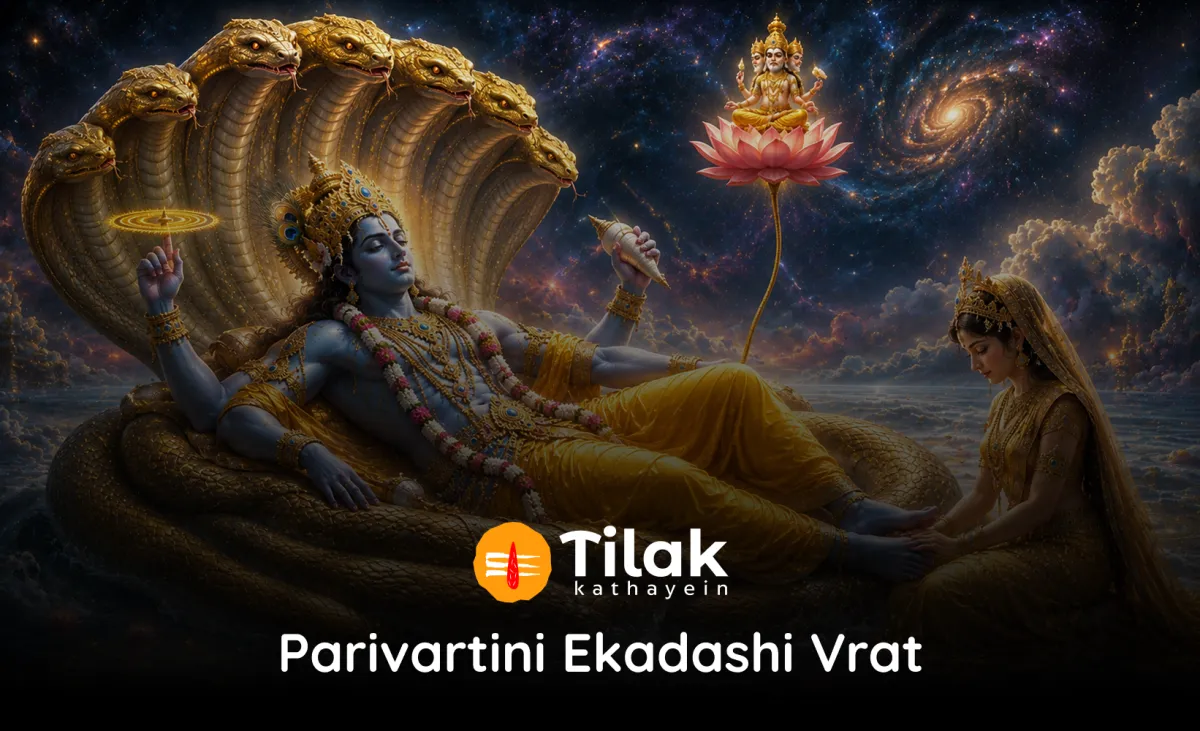
The literal meaning of the word 'Parivartini' is 'change' or 'turning over'. Lord Shri Hari Vishnu goes into yogic slumber in Ksheersagar for four months from Devashayani Ekadashi of the month of Ashadha. Exactly two months after this Chaturmas sleep, on the Ekadashi of Bhadrapada Shukla, Lord Vishnu turns in his sleep (from left to right). It is due to this divine moment of the Lord turning over that this Ekadashi is called 'Parivartini Ekadashi'.
On this auspicious date, Lord Vishnu, in his fifth incarnation as Vamana, vanquished the ego of the demon king Bali and returned the three worlds to Lord Indra. Therefore, worshipping the Vamana form of Lord Vishnu on this day yields immense merit, equivalent to performing a Vajapeya Yajna.
Significance of Parivartini Ekadashi
During the Mahabharata era, Dharmaraj Yudhishthira humbly asked Lord Krishna, "O Janardana! You have narrated the glory of Aja Ekadashi, the Ekadashi of Bhadrapada Krishna, in detail. Now, please tell me the name, glory, and fasting method of the Ekadashi of Bhadrapada Shukla."
Then Lord Krishna said, "O son of Kunti! This Ekadashi of the Shukla Paksha of Bhadrapada is the destroyer of all sins and ultimately grants liberation. It is called Padma, Vamana, or Parivartini Ekadashi. The devotee who worships me with lotus flowers on this day truly attains the merit of worshipping the Trimurti (Brahma, Vishnu, Mahesh)."
The Lord further explained that observing this fast on this day eradicates misfortune, planetary afflictions, and poverty from the devotee's life. Since the preserver of creation himself turns over on this day, a special positive energy permeates the universe at this time. The merit of charity, chanting, penance, and night vigil on this day increases manifold.
Vrat Katha of Parivartini Ekadashi (The Episode of Lord Vamana and King Bali)
Krishna said, "O King! Now listen to the story that destroys all sins. In the Treta Yuga, there was a demon named Bali. He was my ardent devotee. He used to worship me with various Vedic hymns and regularly worshipped Brahmins and performed sacrifices. However, due to his animosity towards Indra, he conquered Indraloka and all the gods."
For this reason, all the gods gathered, deliberated, and went to the Lord. The gods, including Brihaspati and others, approached the Lord, bowed down, and worshipped and praised the Lord with Vedic mantras. Thus, I took my fifth incarnation in the form of Vamana and then, with immense radiance, conquered King Bali.
Hearing this, King Yudhishthira asked, "O Janardana! How did you, in the form of Vamana, conquer that mighty demon?" Krishna replied: I, as the Vamana-form mendicant, asked Bali for three feet of land, saying: "This is equal to the three worlds for me, and O King, you must give it to me."
King Bali, considering this a trivial request, pledged three feet of land to me, and I expanded my Trivikrama form to such an extent that my foot was placed on the Earth, my shank in Bhuvarloka, my waist in Swargaloka, my abdomen in Maharloka, my heart in Janaloka, my throat in Yamaloka, my face in Satyaloka, and my head above it.
The Sun, Moon, and other celestial bodies, yogas, constellations, gods like Indra, and serpents like Shesha prayed in various ways with Vedic hymns. Then, taking King Bali's hand, I said, "O King! The Earth is covered by one foot, and Swargaloka by the second. Where shall I place the third foot?"
Then Bali bowed his head, and I placed my foot on his head, sending my devotee to the netherworld. Seeing his plea and humility, I said, "O Bali! I will always remain near you." Upon the words of Bali, the son of Purochana, my idol was established at Bali's hermitage on the Ekadashi of Bhadrapada Shukla.
Similarly, the second was in Ksheersagar on the coils of Sheshanaga! O King! On this Ekadashi, the Lord turns in his sleep, so the Lord Vishnu, the master of the three worlds, should be worshipped on this day. On this day, it is appropriate to donate copper, silver, rice, and curd. Night vigil must be observed.
Those who observe this Ekadashi fast according to the prescribed method are freed from all sins, go to heaven, and shine like the moon, gaining fame. Those who read or listen to this sin-destroying story receive the merit of a thousand Ashwamedha Yajna.
Parivartini Ekadashi Fast and Worship Method
The fast of Parivartini Ekadashi is considered to begin from the evening of Dashami Tithi. The complete scriptural method of this fast is as follows:
- Rules of Dashami: Consume completely sattvic food on the night of Dashami Tithi, observe celibacy, and keep the mind calm.
- Morning Vow: Wake up in the Brahma Muhurta on the day of Ekadashi, bathe with water mixed with Ganga water, and wear yellow or clean clothes. Thereafter, holding water, akshat (unbroken rice), and flowers in your hand, take a vow for the Ekadashi fast before Lord Vamana and Shri Hari Vishnu.
- Worship Materials and Offering: Install an idol of Lord Vishnu or his Vamana avatar at the place of worship. Bathe them with Panchamrita (a mixture of five nectars). Subsequently, offer yellow clothes, yellow flowers, lotus seeds, seasonal fruits, incense, lamps, and especially Tulsi leaves (note: Tulsi is not plucked on Ekadashi; it should be plucked a day in advance).
- Charity Rule: Donating curd, rice, copper, or silver on this Ekadashi is considered extremely auspicious and bestows inexhaustible merit in the scriptures.
| Time / Period | Religious Rituals and Duties |
|---|---|
| Morning (Brahma Muhurta) | Bathing, offering Arghya to the Sun, and mental and water vow. |
| Forenoon (8 to 10 AM) | Panchamrita Abhishek of Lord Vamana, Shodashopachara Puja, and listening to the Vrat Katha. |
| Throughout the Day | Remain on a fruit-based diet, observe silence, or continuously chant the mantra 'Om Namo Bhagavate Vasudevaya' mentally. |
| Evening | Light a ghee lamp near the Tulsi plant and at the main entrance, recite Vishnu Sahasranama. |
| Night | Meditate on the Lord's slumber festival, engage in devotional singing and night vigil. |
| Dwadasi Morning (Parana) | After bathing, offer food and dakshina to Brahmins or the needy, and break the fast at an auspicious time. |
What to Eat and What Not to Eat During Parivartini Ekadashi Fast?
Purity in diet is considered most important during the Ekadashi fast. Follow the rules as follows:
What can be eaten (Fruitarian diet):
- Fruits and Nuts: Fresh seasonal fruits (apples, bananas, papayas, etc.), almonds, cashews, makhana (fox nuts), raisins, and coconut.
- Dairy Products: Fresh cow's milk, yogurt, buttermilk, paneer (Indian cottage cheese), and pure ghee made at home.
- Fasting Ingredients: Kuttu ka atta (buckwheat flour), singhare ka atta (water chestnut flour), sabudana (tapioca pearls), samak rice (millet), and potatoes/sweet potatoes.
- Spices: Use only rock salt, black pepper, and cumin for cooking.
What to strictly avoid (Forbidden items):
- Complete Abstinence from Rice: Eating rice on Ekadashi is considered a sin equivalent to consuming the limbs of Maharishi Medha, so stay completely away from rice.
- Grains and Pulses: Wheat, barley, corn, gram flour, urad dal, masoor dal, and any other grains are strictly forbidden.
- Tamasic Foods: Avoid garlic, onions, meat, alcohol, eggplant, masoor dal, and stale food.
- Negative Thoughts: Not only should one abstain from food, but one should also avoid anger, false speech, envy, and slander on this day.
Miraculous Benefits of Parivartini Ekadashi Fast
- Merit of Vajapeya Yajna: According to scriptures, observing the Parivartini Ekadashi fast properly yields divine results equivalent to Ashwamedha and Vajapeya Yajna.
- Destruction of Unintentional Sins: By the grace of Lord Vishnu's Vamana form, all physical, verbal, and mental sins committed knowingly or unknowingly are washed away.
- Grace of Shri Hari and Mother Lakshmi: Since this Ekadashi is also called 'Padma Ekadashi', worshipping with lotus flowers on this day ensures that there is never a lack of wealth and grains in the home, and stable Lakshmi resides there.
- Pitra Dosha and Suffering Relief: Due to the पुण्य (merit) of this fast, the ancestors of the lineage are satisfied, and the devotee receives protection from untimely death and calamities.
- Attainment of Moksha: Those who observe this fast with devotion enjoy all worldly pleasures and ultimately attain the supreme abode of Lord Vishnu (Vaikuntha).
Frequently Asked Questions (FAQs)
When is Parivartini Ekadashi in 2026?
In the year 2026, the fast of Parivartini Ekadashi (Padma / Vamana Ekadashi) will be observed on Tuesday, September 22, 2026. The auspicious time for breaking the fast (Parana) on Dwadashi Tithi will be after sunrise on September 23rd.
Why is it called 'Parivartini Ekadashi'?
During the four months of yogic slumber in Chaturmas, Lord Shri Hari Vishnu turns in his sleep on the Ekadashi of the Shukla Paksha of the month of Bhadrapada. Due to this turning over while in a sleeping posture, this auspicious date is called 'Parivartini Ekadashi'.
Which deity is worshipped on Parivartini Ekadashi?
On this day, special worship and adoration of Lord Vamana, the fifth incarnation of Lord Vishnu, is performed. Worshipping Lord Vishnu and Mother Lakshmi with lotus flowers is also considered highly meritorious.
Why is eating rice forbidden on Ekadashi?
According to mythological belief, Maharishi Medha sacrificed his body, and his parts merged into the earth and emerged as barley and rice. Rice is considered to have a living form on Ekadashi, hence eating rice on Ekadashi is considered a sin akin to killing a living being. From a scientific perspective, rice has a high water content, which increases mental restlessness during the fast.
Can sick, elderly, or pregnant women observe this fast?
According to scriptures, physically unwell individuals, the elderly, pregnant women, or nursing mothers should not observe a strict or waterless fast. They can observe the fast's rules by consuming milk, fruits, makhana, or having a fruit-based meal once. Devotion to the Lord is paramount, not rigid adherence.
Conclusion: The Turning Lord and the Devotee's Surrender
Parivartini Ekadashi does not merely teach us the discipline of a fast, but it teaches us to 'surrender everything' like King Bali. When a person surrenders their ego and 'self' at the feet of the Lord, the Lord himself becomes their protector and friend.
On this auspicious occasion of the Bhadrapada Shukla Ekadashi, worship Lord Vamana and Shri Hari Vishnu. Perform charity and good deeds according to your faith and capacity, and pray to the Lord for righteousness, peace, and joy in your life.
Om Namo Bhagavate Vasudevaya. Jai Shri Vamana Deva! Jai Ekadashi Mata! 🙏🚩
Today's Panchang 20 September 2026
For auspicious times, choghadiya, horoscope and planetary positions
Related Articles

Parama Ekadashi Vrat | Parama Ekadashi Vrat Katha in Hindi
परमा एकादशी व्रत कथा हिंदी में पढ़ें। जानें परमा एकादशी का महत्व, पूजा विधि, व्रत नियम, शुभ मुहूर्त, कथा और भगवान विष्णु की कृपा प्राप्त करने के धार्मिक लाभ।

Amalaki Ekadashi | आमलकी एकादशी – व्रत कथा, विधि और लाभ 2026
आमलकी एकादशी 2026 – व्रत कथा, विधि, क्या खाएं, शुभ मुहूर्त और लाभ। भगवान विष्णु की कृपा पाएं।
Devutthana Ekadashi | देवउठनी एकादशी – व्रत कथा, विधि और लाभ 2026
देवउठनी एकादशी 2026 – व्रत कथा, विधि, क्या खाएं, शुभ मुहूर्त और लाभ। भगवान विष्णु की कृपा पाएं।
Devshayani Ekadashi in Hindi | Devshayani Ekadashi Vrat Katha - 2026
देवशयनी एकादशी भगवान विष्णु को समर्पित अत्यंत पवित्र एकादशी है, जिसके साथ चातुर्मास का शुभारंभ माना जाता है। पौराणिक मान्यता के अनुसार, इस दिन भगवान विष्णु चार माह के लिए योगनिद्रा में चले जाते हैं। इस लेख में जानें देवशयनी एकादशी की व्रत कथा, पूजा विधि, शुभ मुहूर्त, धार्मिक महत्व, चातुर्मास का महत्व और इस व्रत से मिलने वाले आध्यात्मिक लाभ।

Apara Ekadashi | अपरा एकादशी – व्रत कथा, विधि और लाभ 2026
अपरा एकादशी 2026 – व्रत कथा, विधि, क्या खाएं, शुभ मुहूर्त और लाभ। भगवान विष्णु की कृपा पाएं।

Saphala Ekadashi | सफला एकादशी – व्रत कथा, विधि और लाभ 2026
सफला एकादशी 2026 – व्रत कथा, विधि, क्या खाएं, शुभ मुहूर्त और लाभ। भगवान विष्णु की कृपा पाएं।